
Family reviewing structured settlement annuity contract documents at home dining table with calculator and legal paperwork
Structured Settlement Death Benefits After the Payee Dies

Content
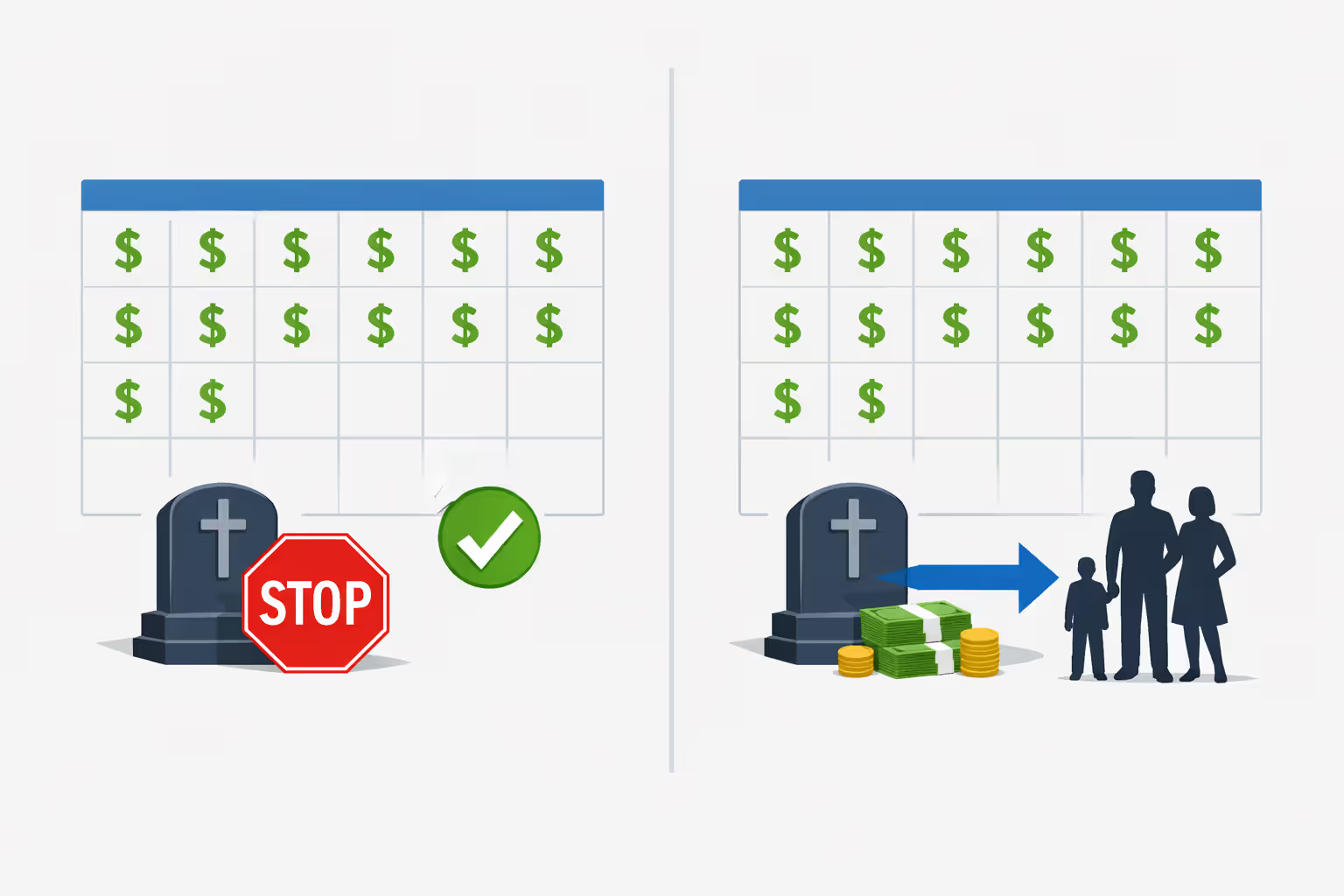
Here's something most people don't realize until it's too late: your structured settlement payments might stop the moment you die. No automatic transfer to your spouse. No continued income for your kids. Just... nothing.
I've seen it happen dozens of times. A family counting on those monthly checks suddenly finds out the hard truth—Dad never set up death benefits when he signed his settlement papers fifteen years ago. The insurance company? They're keeping every penny of the remaining payments. Completely legal.
The difference between a settlement that protects your family and one that doesn't comes down to decisions made during those initial negotiations. What sounds like boring contract language—"20 years certain" versus "life only"—can mean the difference between your kids getting $300,000 or getting zero.
How Structured Settlements Handle Death of the Payee
Nobody's mailing you a reminder to set up death benefits. The insurance company issuing your annuity won't bring it up. And once you've signed those settlement documents? Good luck changing anything.
Death benefits in structured settlements work backwards from what most people expect. They're not included unless you specifically negotiate for them upfront. Miss that window during settlement talks, and your beneficiaries are out of options.
Contractual Provisions That Determine Payment Continuation
Every structured settlement runs on an annuity contract—the actual insurance policy funding your payments. Buried in that contract (usually pages 8-12) sits the language controlling what happens when you die.
Your settlement attorney and the defendant's insurance company hammered out these terms during negotiations. Maybe you were focused on the monthly payment amount and glossed over the death benefit discussion. Maybe your lawyer never explained the options clearly. Either way, whatever made it into that final contract is now permanent.
Here's a real example: Tom settled his injury case in 2018 for $1,800 monthly for 30 years—total value around $648,000. His contract included zero death benefit language. He died in a car accident in 2023 after receiving just $97,200 in payments. His wife and two teenage daughters? They got nothing. The insurance company kept the remaining $550,800.
Compare that to Sarah's settlement, also from 2018. She negotiated "25 years certain" on her $1,500 monthly payments. When she died unexpectedly in 2022, her parents continued receiving those $1,500 checks. They'll keep getting them through 2043—a total of $315,000 still coming to the family.
The only difference was three words in the contract: "25 years certain."
Life-Contingent vs. Guaranteed Period Provisions
"Life contingent" means exactly what it sounds like—payments stop when your life stops. Period. Doesn't matter if you've collected for 30 years or 30 days.
Why would anyone structure a settlement this way? Simple: you get more money each month. That insurance company calculates risk. If they only have to pay while you're breathing, they'll pay you more per check. A 45-year-old might get $2,400 monthly life-only versus $1,850 monthly with a 20-year guarantee.
That extra $550 per month ($6,600 yearly) seems attractive until you run the math on what your family loses if you die at 55. With life-only, they get zero. With the 20-year guarantee, they'd still receive another 10 years of payments—$222,000 total.
Guaranteed periods come in standard packages: 5, 10, 15, 20, 25, or 30 years. Some settlements combine approaches—"lifetime payments with 15 years certain" means you get paid for life, but if you die during those first 15 years, your beneficiaries collect the remaining guaranteed payments.
Think of it like buying insurance on your insurance. You're trading some monthly income now for protection later. Whether that trade makes sense depends on your age, health, financial situation, and family needs.
Author: Danielle Morgan;
Source: avayabcm.com
Who Receives Structured Settlement Payments After Death
Beneficiary forms for structured settlements look deceptively simple. One page, a few blanks to fill in. But mess this up and you've created a legal nightmare for your family.
Primary vs. Contingent Beneficiaries
Your primary beneficiary gets first dibs on any death benefits. Seems obvious, right? But here's where it gets interesting.
You're allowed to split benefits among multiple primaries. Say you name your three kids as equal primaries—they'd each get 33.3% of continuing payments. Or you could do an unequal split: 50% to your spouse, 25% to each of two children.
Now let's say you've named your sister as primary beneficiary, but she dies before you do. If you never updated that form, your benefits might not go where you think. This is where contingent beneficiaries (the backups) become critical.
I worked with a family in 2021 where the deceased had named his mother as primary and his brother as contingent. Mom had died three years earlier, but he'd never filed an updated form. The brother (contingent) should've received the benefits, right? Wrong. The insurance company said that without a valid primary beneficiary, the whole thing defaulted to the estate. Two years of probate court later, the brother finally got access to the money—minus about $35,000 in legal fees.
Here's another wrinkle most people miss: per stirpes designations. Fancy Latin term that means "by branch." If you designate your daughter as beneficiary "per stirpes" and she dies before you, her kids (your grandkids) step into her shoes automatically. Without that two-word phrase, her entire share gets redistributed to your other named beneficiaries instead.
Estate as Default Beneficiary
When you've either named nobody or all your named beneficiaries are dead, the money dumps into your estate. This is almost always the worst possible outcome.
First problem: probate. Your estate has to go through court proceedings that are public record, take 9-18 months minimum, and cost 3-7% of the estate's value in legal and administrative fees. That structured settlement death benefit of $400,000? Could easily burn through $25,000 in probate costs.
Second problem: creditors. Money paid to named beneficiaries typically has protection from creditors. Money sitting in an estate? Fair game. Had credit card debt, medical bills, or a lawsuit pending when you died? Those creditors can stake claims against your estate, potentially gobbling up settlement money you intended for your kids.
Third problem: estate taxes. While the federal estate tax doesn't kick in until $13.61 million, several states start taxing estates at much lower thresholds. Massachusetts hits you at $1 million. Oregon at $1 million. Connecticut at $9.1 million. If you live in these states and your total estate (including the present value of your remaining settlement payments) crosses these limits, your heirs will owe taxes that proper beneficiary planning could have avoided entirely.
Four Common Death Benefit Options in Settlement Annuities
During settlement negotiations, you're essentially shopping from a menu of death benefit structures. Each one fundamentally changes how much you get now versus what your family gets later.
| Structure Type | What Happens When You Die | Your Beneficiaries' Options | Counts Toward Your Estate? | Best For |
| Life Only | Payments stop immediately; insurance company keeps everything | Nothing—all remaining money stays with insurer | No (because there's no benefit) | People wanting maximum monthly income who have no dependents or separate assets for heirs |
| Period Certain | Payments continue for the full guaranteed period you chose | Can keep receiving monthly payments or request discounted lump sum | Yes, if you die before the guaranteed period ends | Younger settlement recipients who want to balance current income with family protection |
| Installment Refund | Payments continue until beneficiaries have received at least what the insurance company originally paid for your annuity | Monthly payments continue until the total refund amount is paid | Yes, for whatever refund amount remains unpaid | Anyone wanting to guarantee their family gets at least the full settlement value |
| Cash Refund | All remaining payments stop; beneficiaries get one lump sum payment | Single lump sum equal to original annuity cost minus what you already collected | Yes, the full remaining lump sum value | Beneficiaries who need immediate access to cash rather than managing long-term payments |
Life Only gives you the biggest checks but offers zero protection for your family. Let's use real numbers: a 50-year-old woman with a $500,000 settlement might receive $2,700 monthly for life only. Sounds great. But if she dies at age 51 after collecting just $32,400, her family gets nothing. The insurance company pockets the remaining $467,600.
This structure only makes sense in specific situations. Maybe you're 70 years old with no kids and no spouse. Maybe you have a $2 million life insurance policy already protecting your family. Maybe you have a terminal diagnosis and want maximum income during your remaining time. Otherwise? You're gambling with your family's financial security.
Period Certain structures are the most popular because they offer balance. The "certain" means guaranteed—that's how many years the insurance company must keep paying, whether you're alive or not.
Take that same 50-year-old woman with a $500,000 settlement. Structure it as "$2,100 monthly for 25 years certain" and she's protected her family. If she dies at 51, her beneficiaries receive $2,100 monthly for the next 24 years—a total of $604,800. Yes, she gave up $600 per month compared to life-only ($7,200 yearly), but she bought $604,800 of protection for her family.
Many contracts give beneficiaries a choice: keep the monthly payments or take a lump sum. That lump sum gets discounted to "present value" (insurance company math for "we're keeping some money because we're paying you early"). Expect roughly 40-60% of the total remaining payment value if you want cash now.
Installment Refund provisions guarantee your family gets at least what the insurance company originally paid. If they spent $400,000 buying your annuity and you die after receiving $175,000, your beneficiaries will get the remaining $225,000—either as continued monthly payments or (sometimes) as a discounted lump sum.
This protects against dying shortly after settlement but doesn't provide benefits beyond that refund amount. If you live long enough to collect more than the original $400,000, there's nothing left to refund.

Author: Danielle Morgan;
Source: avayabcm.com
Cash Refund works the same way but automatically pays beneficiaries a lump sum instead of continued monthly checks. If you're worried your beneficiaries can't manage monthly payments responsibly, this structure hands them one check and finishes the obligation.
The downside? That lump sum typically gets heavily discounted. Your beneficiaries might receive 50-70 cents on the dollar compared to the total value of remaining payments. But they get immediate access to cash for funeral expenses, debt repayment, or emergency needs.
Some settlements get creative by combining structures. "Life with 20 years certain" is common—you get lifetime income, but if you die within the first 20 years, your beneficiaries receive the remaining guaranteed payments. After 20 years, the guarantee ends and you're back to life-only terms.
Tax Implications for Beneficiaries Receiving Death Benefits
The tax rules for inherited structured settlement payments trip up even experienced tax professionals. The outcome depends on several factors that interact in non-obvious ways.
When your original settlement qualified as tax-free under IRC Section 104(a)(2)—meaning it came from physical injury or physical sickness—those payments stayed tax-free in your hands. The question is whether that same tax-free status extends to your beneficiaries.
Generally speaking, yes. When beneficiaries receive continued periodic payments from a qualified tax-free settlement, those payments remain tax-free. Your daughter receiving your $1,800 monthly payment after you die doesn't pay income tax on that $1,800.
But here's the complication.
The settlement proceeds themselves maintain their tax-exempt status when passing to beneficiaries.The problem area is any interest or earnings that accrue after the original payee's death. If beneficiaries receive a lump sum representing future payments, part of that lump sum might represent earnings rather than settlement proceeds—and those earnings could be taxable. The dividing line isn't always clear-cut, which is why beneficiaries should get a tax professional involved before accepting lump sum buyouts
— Jennifer Martinez
Estate taxation works independently from income taxation. The IRS calculates the present value of all your remaining guaranteed payments and includes that amount in your gross estate. For someone with $300,000 in remaining guaranteed payments, that $300,000 gets added to their house value, bank accounts, life insurance, and everything else when determining if their estate crosses the $13.61 million federal threshold.
Most families never hit that federal number. But watch out for state-level estate or inheritance taxes with much lower triggers. New Jersey charges inheritance tax on amounts exceeding $500,000 for certain beneficiary classes. Pennsylvania's inheritance tax has no threshold at all—it taxes everything going to non-spouse beneficiaries at rates from 4.5% to 15%.
Beneficiaries also lose the "step-up in basis" that typically helps with inherited assets. When you inherit stock, its cost basis resets to the value at death, potentially eliminating capital gains. Structured settlements don't work that way because they're classified as "income in respect of a decedent" (IRD). This means if your beneficiaries sell their inherited payment rights to a factoring company, they can't claim a capital loss even if they sell for significantly less than the present value.
The interaction between these various tax rules creates planning opportunities and traps. Anyone inheriting substantial structured settlement death benefits should consult both a CPA familiar with IRC Section 104(a)(2) and an estate planning attorney before making decisions about lump sum elections or payment sales.
Steps Beneficiaries Must Take to Claim Settlement Death Benefits
Insurance companies won't track down your beneficiaries and hand them money. The burden falls entirely on beneficiaries to initiate claims, provide documentation, and follow up persistently.
Required Documentation and Proof of Death
Start by getting 5-7 certified copies of the death certificate from the funeral home or vital records office. Photocopies won't work—insurance companies, banks, and government agencies all require certified originals with the raised seal.
Next, locate the structured settlement paperwork. You need the annuity contract or policy number, insurance company name, and contact information. Check the deceased's filing cabinet, safe deposit box, or ask their attorney. If you're completely stuck, contact the attorney who handled the original case—they should have copies.
Call the insurance company's death claims department (sometimes called "annuity beneficiary services" or similar). Explain that the annuitant has died and you're the named beneficiary. They'll mail or email a claims packet with specific forms required by that company.
You'll submit proof of your own identity—typically a driver's license or passport plus Social Security card. You'll also need documentation showing you're actually the designated beneficiary. The insurance company should have this in their files, but bringing your own copy of the relevant pages from the annuity contract speeds things up.
If you're a contingent beneficiary claiming because the primary beneficiary died before the annuitant, bring death certificates for those primary beneficiaries too. The insurance company needs to verify the entire beneficiary chain.
The IRS Form W-9 is usually required even for tax-exempt payments. The insurance company must report payments made, and they need your Social Security number or tax ID to file their 1099 forms (even if those forms ultimately show zero taxable income).
Some structured settlements involve "qualified assignments"—a legal arrangement where the defendant transferred their payment obligation to a third-party assignment company. In these cases, contact the assignment company rather than going directly to the insurance carrier. The assignment company intermediates all beneficiary claims.

Author: Danielle Morgan;
Source: avayabcm.com
Timeline and Processing Expectations
Plan for 60-90 days between submitting your completed claim packet and receiving your first payment or lump sum. That's assuming you submit everything correctly the first time with no missing information.
Reality check: most claims take longer because of missing documents, unclear beneficiary designations, or disputes among multiple beneficiaries. I've seen claims stretch to six months or more when complications arise.
Here's an annoying timing issue: the deceased's final payment usually gets deposited to their bank account before the insurance company processes the death claim. That's money that technically belongs to the estate. You'll need to work with the estate executor to either return it or properly account for it in estate settlement. Don't just keep it and hope nobody notices—that can create legal problems.
Many insurance companies freeze all payments the moment someone reports a death, even before receiving official documentation. This prevents overpayments but can blindside beneficiaries expecting immediate income continuation. Budget for at least a 60-90 day gap without payments.
If your death benefit option allows choosing between continued monthly payments or a lump sum, you'll get an election form with a deadline—typically 30-90 days after claim approval. Miss that deadline and you're stuck with whatever the default option is (usually continued monthly payments).
International beneficiaries face extra bureaucracy. The IRS may require you to obtain an Individual Taxpayer Identification Number (ITIN) if you don't have a Social Security number. That process alone takes 7-12 weeks. International wire transfer fees can also eat into your payment amounts in ways domestic direct deposits don't.
Mistakes That Can Forfeit Structured Settlement Death Benefits
Some errors wipe out benefits entirely. Others create legal battles that drain money and time. Nearly all of them stem from decisions made years before death—decisions that seemed minor at the time.
People treat beneficiary designation forms like throwaway paperwork.I had a client who filled out his structured settlement beneficiary form in 1995 naming his parents. He got married in 1998, had three kids by 2005, divorced in 2010, remarried in 2013. When he died in 2022, his 90-year-old mother—who he'd barely spoken to in years—received $450,000 in death benefits. His current wife and kids got nothing because he never updated that form from 27 years earlier
— Robert Chen
The single biggest mistake? Never designating beneficiaries at all. Some people assume the law automatically gives benefits to spouses or children. It doesn't. Without explicit written beneficiary designations, most structured settlements either stop paying entirely or dump everything into the estate where probate and creditors tear it apart.
Divorce is another landmine. Most people assume divorce automatically removes an ex-spouse as beneficiary. Some states have laws attempting to accomplish this, but those laws don't apply consistently to all structured settlement contracts. Some annuity contracts explicitly state that divorce doesn't change beneficiary designations unless you file updated paperwork. I've seen ex-spouses collect death benefits from settlements established during the marriage, leaving current spouses with nothing.
Naming minor children directly as beneficiaries—without a trust—creates a guardianship mess. Insurance companies cannot legally hand $200,000 to a 14-year-old. Courts must appoint a guardian, which costs $5,000-$15,000 in legal fees. That guardian then operates under court supervision (more fees, more delays) until the child turns 18 or 21 depending on state law. At that point, the now-adult child gets full control of all remaining money, whether they're mature enough to handle it or not.
Better approach: name a trust as beneficiary with a trustee managing distributions according to your instructions. The trust can control when and how money gets distributed—college expenses only, monthly allowances until age 30, whatever you want.
Failing to update contact information for your beneficiaries causes surprising problems. If the insurance company can't locate your named beneficiary, they may hold the funds in suspense for years. After enough time passes (varies by state, typically 3-5 years), they might classify the money as abandoned property and turn it over to the state's unclaimed property division. Your beneficiary then has to navigate state bureaucracy to recover what should have been a simple claim.
Some people make beneficiary designation mistakes during divorce proceedings. Maybe your settlement was considered marital property, and the divorce decree awards your ex-spouse "50% of the structured settlement death benefits." Problem: that divorce decree doesn't automatically update the insurance company's records. You need to file formal paperwork with the insurance company splitting the beneficiary designation. Without that step, your ex might get nothing despite the divorce decree's language.
Assuming you can easily change beneficiaries later is another trap. While most structured settlements do allow beneficiary updates, some—particularly those established through qualified assignments or certain types of trust arrangements—restrict or prohibit changes entirely. Read your contract carefully, and if changes aren't allowed, your original designation is even more critical.

Author: Danielle Morgan;
Source: avayabcm.com
Missing claim filing deadlines can cost your beneficiaries everything. While structured settlement death benefits don't typically "expire" like insurance claims, some states impose statutes of limitation ranging from 1-5 years. After that window closes, recovering benefits requires litigation with uncertain outcomes. The insurance company isn't trying to cheat anyone—they're following legal rules about claim timeliness.
Frequently Asked Questions About Structured Settlement Death Benefits
Pull out your structured settlement paperwork right now. Find the section describing death benefits—usually in the annuity contract rather than the settlement agreement itself. Read exactly what it says about payment continuation after your death.
If you don't like what you see, you can't change the payment structure, but you can adjust your beneficiary designations (assuming your contract allows changes). You can also build protection through other estate planning tools: life insurance, trusts, or other investments designed to supplement whatever death benefits exist in your settlement.
For those currently negotiating new settlements, the death benefit conversation needs to happen upfront. Yes, adding guaranteed payment periods reduces your monthly amount. Maybe that reduction is 10%, maybe it's 20%. But that's the price of ensuring your family doesn't lose everything if you die unexpectedly.
Think about it this way: would you rather have $2,500 monthly for life-only, or $2,100 monthly with 25 years guaranteed? If you die after 20 years, you personally received $120,000 less ($400/month × 240 months). But your family receives $126,000 they wouldn't have gotten otherwise ($2,100/month × 60 remaining months). Which outcome matters more to you?
For beneficiaries who've lost someone receiving structured settlement payments, time matters. Contact the insurance company within days, not weeks or months. Gather death certificates immediately. Submit claim paperwork as soon as you receive it. Every delay extends the period without payments and increases the chances of complications.
The complexity of structured settlement death benefits makes professional guidance worth every penny. Estate planning attorneys structure beneficiary designations to minimize taxes and avoid probate—their fees ($1,500-$5,000 typically) are tiny compared to the protection they create. Tax professionals clarify income and estate tax implications specific to your situation. Structured settlement consultants explain how various contract provisions affect both lifetime payments and survivor benefits.
What you negotiated during your settlement—or what you do now to protect your beneficiaries—determines whether your family inherits financial security or a legal nightmare. Choose carefully.