
Actuary desk with mortality tables, calculator, survival curve charts and computer spreadsheet for structured settlement calculations
How Life Expectancy Tables Affect Structured Settlement Payments

Content
Insurance companies funding structured settlements rely on something far more precise than guesswork. Every payment stream you'll receive over the coming decades stems from detailed actuarial work—calculations built on mortality data, economic forecasts, and medical assessments. At the heart of these numbers sit life expectancy tables, statistical tools that help determine what your future payments are worth today and how much cash an insurer needs to set aside.
Why should this matter to you? Because the choice between different mortality tables can swing settlement values by 20% or more in either direction. That's not pocket change—it's the difference between receiving $3,200 monthly versus $3,800, or accepting a present value calculation of $800,000 instead of $950,000. Whether you're the plaintiff negotiating terms, an attorney protecting your client's interests, or a financial advisor evaluating proposals, understanding how these tables work gives you leverage.
What Life Expectancy Tables Determine in Structured Settlements
Think of mortality tables as massive spreadsheets tracking death rates across different ages, genders, and sometimes health profiles. Actuaries consult these tables to estimate survival probabilities—not for you specifically, but for people similar to you statistically.
These tables accomplish three essential tasks in settlement work. They project how many years someone will likely receive lifetime payments, which directly impacts how much money must be invested upfront. They enable present value calculations—converting a stream of future payments into today's dollars. And they allow fair comparisons between competing offers: Should you take $2,500 monthly for life or a $600,000 lump sum? Without mortality statistics, that's impossible to evaluate.
Here's where it gets interesting. The Individual Annuity Mortality tables don't track average Americans—they track people who actually buy annuities. This matters because annuity purchasers live longer than typical folks. Why? Healthy people concerned about outliving their money buy annuities. Seriously ill people often don't. Actuaries call this "mortality selection," and it means IAM tables show lower death rates than general population statistics would suggest.

Author: Andrew Halvorsen;
Source: avayabcm.com
Standard tables assume you're in average health for your age and gender. But what if you're not? A 35-year-old who survived a severe car accident and now lives with paraplegia doesn't have the same longevity outlook as someone without those injuries. This is where impaired life expectancy enters the picture. Actuaries might calculate that person's payments using mortality assumptions closer to a 55-year-old's statistics—not because they're actually 55, but because their life expectancy resembles that age group's. This distinction reshapes the entire financial equation, sometimes cutting the required funding by 30% or more.
The Actuarial Models Behind Settlement Payment Calculations
Three variables form the foundation of every settlement calculation: projected payment duration, discount rate, and inflation factors. Adjust any one of them, and the final numbers shift substantially.
Discount rates reflect a basic economic principle—money today beats money tomorrow. Would you rather have $100,000 now or $100,000 twenty years from now? Obviously now. But how much less would you accept today to equal that future $100,000? That's what discount rates determine. Settlement actuaries typically reference Treasury yields or corporate bond rates, currently ranging anywhere from 3% to 6% depending on market conditions. When rates climb higher, present values shrink. A defendant funding your settlement in 2023's higher-rate environment spends less than they would have in 2020's low-rate world—same payment stream, lower cost.
Age affects calculations in obvious ways. A 25-year-old receiving lifetime payments requires far more funding than a 65-year-old getting identical monthly amounts. But here's something many people miss: gender creates substantial differences too. Statistical reality shows women outliving men by several years on average. So a 40-year-old woman receiving $4,000 monthly for life costs more to fund than a 40-year-old man with identical terms. Some argue this constitutes unfair discrimination. Courts and regulators have largely permitted it as actuarially justified, though debates continue.
Health status introduces the wildest variability. Someone with a documented shortened life expectancy might see higher monthly payments from the same funding pool—the insurance company expects to make fewer total payments. This creates an uncomfortable trade-off: accepting an impaired life rating can boost your immediate cash flow, but it requires acknowledging reduced longevity projections.
Fixed payment amounts simplify everything. You'll receive $3,000 monthly, period. But inflation slowly erodes that buying power. What covers your expenses comfortably today might feel tight in fifteen years. Indexed annuities combat this by building in annual increases—often 2% to 4%—that preserve purchasing power. These inflation adjustments complicate the math considerably. Each future payment differs from the last, and compounding over three or four decades drives up the required funding dramatically.
Types of Mortality Tables Used by Settlement Planners
Actuaries select from several mortality table categories depending on who's receiving payments and their health status.
Individual Annuity Mortality tables—currently the IAM 2012 Basic Table—dominate standard structured settlement work. These reflect real-world data from people purchasing commercial annuities. The Society of Actuaries updates IAM tables every decade or so as longevity trends evolve. The 2012 version replaced earlier tables after researchers found annuitants living longer than older projections predicted. Insurers had to increase their reserves accordingly, which ultimately made annuities more expensive to purchase.
Commissioners Standard Ordinary tables, including the 2017 CSO version, originated in life insurance rather than annuity work. Insurance regulators use CSO tables to set reserve requirements for life insurance companies. Some insurers reference CSO tables for particular settlement calculations, especially when dealing with hybrid products combining life insurance features with annuity payments. CSO tables generally reflect higher mortality rates than IAM tables because they're built from broader populations, including people buying life insurance for estate planning rather than longevity protection.
Impaired risk approaches adjust standard tables when claimants have medical conditions shortening life expectancy. Rather than consulting a separate "impaired life table," actuaries usually modify existing tables using rating factors. The "rated age" method is common—treat a 40-year-old with severe diabetes as though they were 50 or 60 for calculation purposes. Alternatively, percentage ratings increase mortality assumptions by specific amounts. A "30% mortality rating" means the actuary assumes death rates 30% higher than standard tables would indicate for that age.
Mortality Table Comparison for Structured Settlements
| Table Name | Best Used For | Who Typically Uses It | What Gets Adjusted | Published By |
| IAM 2012 Basic | Healthy recipients with standard annuities | People without major health impairments | Age and gender factors | Society of Actuaries |
| CSO 2017 | Insurance reserves and some hybrid products | General insured populations | Age, gender, tobacco use | National Association of Insurance Commissioners |
| Rated Age Methodology | Cases involving injury or illness | Catastrophic injuries, chronic conditions, shortened life expectancy | Medical diagnoses, functional limitations, age equivalents | Individual insurance company underwriting teams |
| Annuity 2000 Table | Legacy settlements from earlier periods | Older cases established before 2012 updates | Age and gender factors | Society of Actuaries |
Selecting the wrong table can cost you dearly. Picture a quadriplegic plaintiff whose lifetime payments get calculated using standard IAM assumptions. The insurer would need to set aside substantially more money than if they'd used appropriate impaired life adjustments. In major cases, this difference can reach six figures. That's why medical underwriting isn't just paperwork—it's a negotiating battleground.
How Health Conditions Alter Standard Life Expectancy Assumptions
Medical underwriting for settlements works like life insurance underwriting in reverse. Life insurers want to avoid high-risk applicants. Settlement underwriters need accurate risk assessment to price annuities correctly—which sometimes costs less because of shortened projected lifespans.
Everything starts with your medical records. The insurance company's medical examiner—typically a nurse or physician specializing in life expectancy analysis—reviews your diagnosis history, treatment records, functional assessments, and doctors' prognoses. They're hunting for conditions statistically linked to reduced longevity: heart disease, cancer, organ dysfunction, neurological damage, or multiple conditions that multiply risk.

Author: Andrew Halvorsen;
Source: avayabcm.com
Certain injuries appearing frequently in personal injury cases trigger major rating adjustments. Spinal cord injuries, particularly complete injuries at higher vertebral levels, substantially reduce statistical life expectancy. Complications drive this—respiratory infections, pressure ulcers, cardiovascular problems, and secondary conditions. Someone with C4-C5 complete quadriplegia might face a rated age 25 to 35 years beyond their actual age. Traumatic brain injuries vary wildly in impact. Severe TBI with persistent seizures and cognitive deficits demands different assumptions than mild TBI where someone's made a full recovery.
Cancer history demands nuanced evaluation. A 45-year-old who's five years past treatment for early-stage breast cancer with no recurrence might receive minimal rating or none at all. Someone facing metastatic disease or aggressive cancer types encounters vastly different calculations. Actuaries weigh cancer type, stage at diagnosis, treatment response, and time elapsed since treatment.
Diabetes affects calculations through its long-term complications—cardiovascular disease, kidney dysfunction, neuropathy. Underwriters examine A1C levels, whether complications exist, and treatment compliance. Well-managed diabetes in a younger individual might add just 5-10 years to rated age. Advanced diabetic kidney disease could double or triple that adjustment.
These medical ratings reshape settlement economics dramatically. Suppose standard calculations indicate needing $2 million to fund lifetime payments. Impaired life underwriting drops that to $1.4 million. That's $600,000 in savings for the defendant. Or—and here's where negotiation gets creative—that $600,000 difference could fund substantially higher monthly payments instead. You might accept impaired life pricing in exchange for increased payment amounts, putting more money in your pocket during your actual lifetime even if the spreadsheet shows fewer projected years.
Reading and Interpreting Actuarial Calculation Reports
An actuarial present value report translates abstract math into the concrete numbers driving settlement negotiations. These documents typically run several pages and pack in assumptions, methods, and calculated values under various scenarios.
Check the report header first. It identifies which mortality table they used, what discount rate they applied, and when they ran the calculations. These details aren't trivial. A report using a 5.5% discount rate from 2019 shows completely different values than one using 3.5% in 2023—even for identical payment structures. Always confirm the discount rate matches current market realities and the mortality table fits your situation appropriately.
The payment schedule section lists every future payment: amounts, timing, duration. Verify this matches the proposed settlement terms exactly. One mistake—payments beginning at 65 instead of 60, or annual increases of 2% instead of 3%—can distort the entire calculation by hundreds of thousands.
Present value calculations show what those future payments equal in today's dollars. This figure represents the lump sum needed to fund your payment stream, assuming the stated discount rate and mortality assumptions prove accurate. Reports frequently show multiple scenarios: present value assuming payments for a guaranteed period, present value for lifetime payments, and present value under various longevity assumptions.
People constantly mix up life expectancy with guaranteed payment periods. A claimant might have a calculated life expectancy of 25 years, but their annuity could guarantee payments for 30 years regardless. That guarantee carries real value that should appear in present value calculations—but I've reviewed reports that don't clearly separate life-contingent valuations from period-certain ones
— Jennifer Martinez
Some reports include sensitivity analysis sections demonstrating how changed assumptions affect values. You might see present values calculated at discount rates from 3% to 6%, or using different mortality tables. This reveals the range of reasonable valuations instead of treating one number as absolute truth.
Watch for these warning signs: outdated mortality tables (anything before 2012 for new settlements), discount rates wildly disconnected from current Treasury yields, or missing documentation about medical rating adjustments. If you have significant medical impairments but the report mentions no mortality adjustments, question whether proper underwriting occurred. Conversely, if the report shows rated age adjustments but doesn't reference supporting medical evidence, opposing counsel might challenge it.
Press your settlement consultant or attorney with specific questions. Why this particular discount rate? How does it compare to rates from other insurers? If medical ratings were applied, which specific conditions drove those adjustments? Could we see comparison values under both standard and impaired mortality assumptions? Their answers reveal whether the actuarial work was thorough or rushed.

Author: Andrew Halvorsen;
Source: avayabcm.com
Common Mistakes When Evaluating Life Expectancy Projections
Using outdated mortality tables tops the list of frequent errors. Life expectancy has climbed significantly over recent decades. Tables from the 1990s or early 2000s underestimate longevity, which means they undervalue lifetime payment streams. A defendant pushing for an older table essentially argues they should pay less because people die sooner—an assumption disconnected from current reality for most claimants.
Medical advances complicate long-term projections in fascinating ways. A 30-year-old with spinal cord injury today faces better longevity prospects than someone with identical injuries in 1990. Why? Improved wound care protocols, better wheelchair technology, advances in managing secondary complications. Standard impaired life ratings based on historical data may paint an overly pessimistic picture. This cuts both directions: you shouldn't accept drastically reduced payment projections based on outdated medical assumptions, but you also shouldn't bank on future medical breakthroughs that might or might not materialize.
Author: Andrew Halvorsen;
Source: avayabcm.com
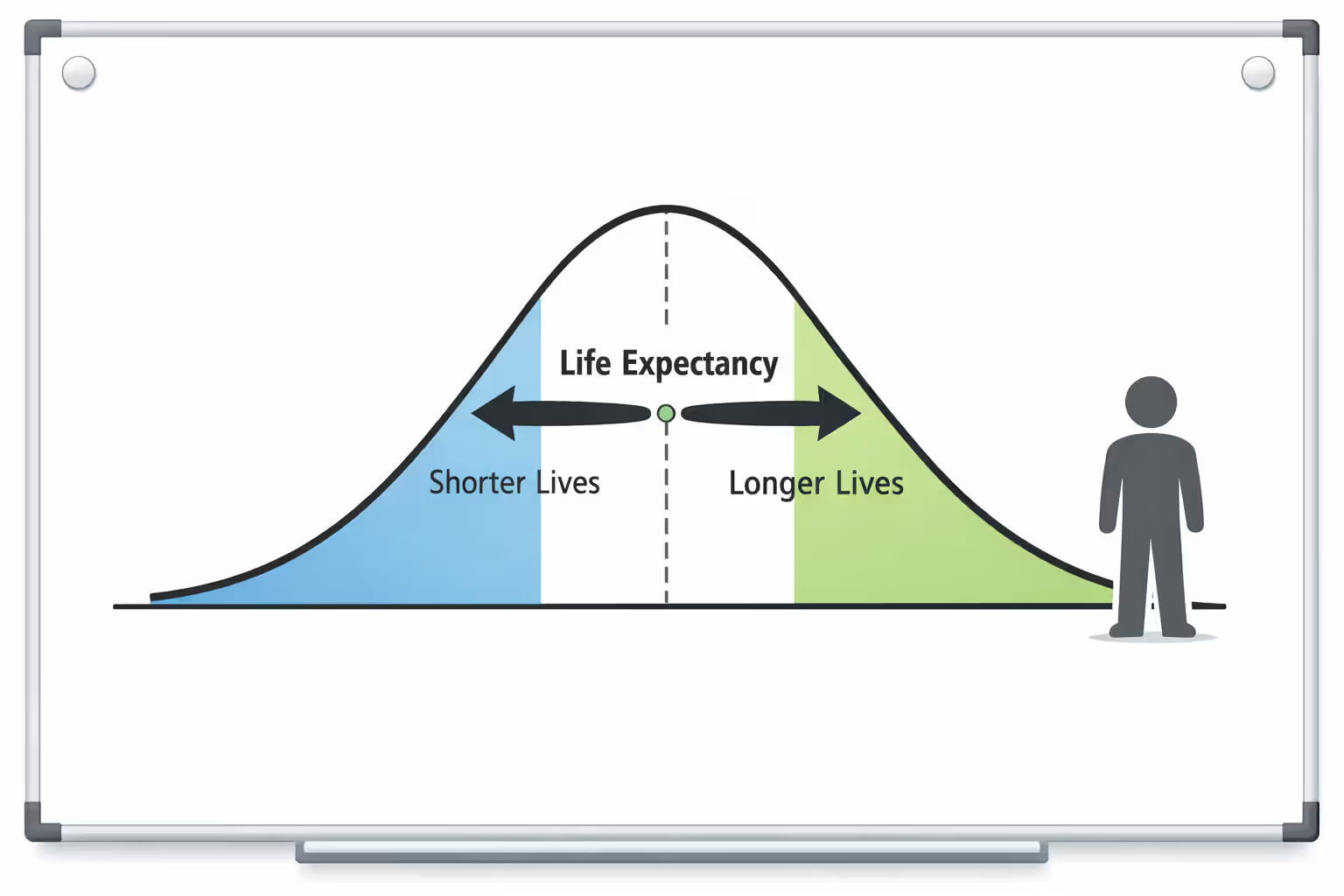
Many folks confuse life expectancy with maximum lifespan—a critical distinction. Life expectancy represents the statistical midpoint. Half of people in your category will live longer, half shorter. A 40-year-old woman with 45-year life expectancy might easily reach 95 or beyond. Structured settlements with lifetime payment guarantees protect against outliving projections. But if you're comparing a lifetime structure to a fixed-period annuity, understand that "life expectancy" marks the middle of a probability curve, not a ceiling.
Failing to account for structured settlement protection features distorts value comparisons. A lifetime annuity with 20-year period certain guarantee continues payments to your beneficiaries if you die early—downside protection that pure life-contingent payments lack. The actuarial value of this guarantee belongs in present value calculations, but simplified analyses sometimes ignore it entirely.
Some claimants mistakenly believe accepting an impaired life rating for calculation purposes constitutes a binding medical prognosis. It doesn't. The mortality assumptions used for annuity pricing represent actuarial estimates based on population statistics, not individual medical predictions. If you outlive the projected life expectancy, payments continue anyway (assuming a lifetime structure). The insurance company shoulders that longevity risk, which is exactly why they price so carefully.
Frequently Asked Questions About Settlement Life Expectancy Tables
Life expectancy tables convert abstract mortality statistics into the concrete financial terms shaping structured settlement negotiations. Whether you're assessing a settlement offer, advising a client, or simply trying to make sense of the numbers in front of you, grasping how actuaries deploy these tables empowers better decisions.
The mathematics balances competing interests effectively. Defendants want certainty about their financial obligations. Plaintiffs need guaranteed income lasting their entire lifetime. Mortality tables provide neutral statistical frameworks both sides can reference.
Pay close attention to which tables appear in your calculations, what discount rates they applied, and whether medical conditions received appropriate consideration. Small assumption differences compound over decades into substantial value gaps. A settlement appearing adequate under one set of actuarial assumptions might prove insufficient under more realistic ones.
Collaborate with professionals who can explain not just final numbers but the assumptions generating them. Challenge reports that seem to rely on outdated data or fail to account for your specific medical situation properly. Actuarial calculations aren't mysterious—they follow logical steps you can understand and, when necessary, dispute.
Remember this above all: these tables inform financial planning but don't dictate individual outcomes. Properly structured settlements with lifetime payment guarantees protect you whether you live longer or shorter than projections suggest. You get financial security regardless of what the mortality tables predicted.