
Calculator, US dollar bills spread on a wooden desk next to a stack of legal documents in a modern office setting
How to Find Out What Your Structured Settlement Is Worth in Cash

Content
You've got a structured settlement paying out over time, and now you're wondering what someone would actually hand you in cash for those future payments. The answer might sting a bit.
Take a settlement that's supposed to pay $200,000 over the next two decades. In today's market, you'd probably walk away with somewhere around $85,000—maybe less. That's a massive gap, and it catches most people completely off guard.
Why such a huge difference? It comes down to discount rates, when you're scheduled to receive money, and what's happening in the buying market right now.
Most folks assume their future payments hold the same value as cash today. They don't. Time changes everything when it comes to money, and buyers factor in risk and their own profit margins before making you an offer.
What Determines Your Structured Settlement's Cash Value
Three main things control what buyers will actually pay you. These factors work together, and once you understand them, you'll know whether you're looking at a fair offer or getting lowballed.
Payment Schedule and Duration
Timing is everything. Buyers will pay significantly more for a $1,000 payment arriving next month compared to that same $1,000 showing up in 2035. Makes sense, right? They're parking their money for way longer on that distant payment.
Settlements loaded toward the front end bring better offers. Let's say your deal pays $50,000 in year one, drops to $30,000 in year two, then levels off at $20,000 annually for eight more years. You'll get better quotes than someone receiving identical total payments spread evenly across the same timeframe. Buyers want their money working sooner rather than later.
How often you get paid matters too. Receiving $1,200 monthly typically generates slightly higher offers than getting one $14,400 check annually, even though the yearly math works out the same. Monthly payments mean steadier cash flow for the buyer and less risk.
Secondary market buyers typically work with discount rates running anywhere from 9% up to 18%. What that means for sellers is you're looking at getting somewhere between 40 and 60 cents on the dollar for what's left in your payment stream. Where you land in that range depends on how long your payments stretch out, what your state requires, and how many companies are competing for your business right now
— James Dolan
Discount Rate Impact
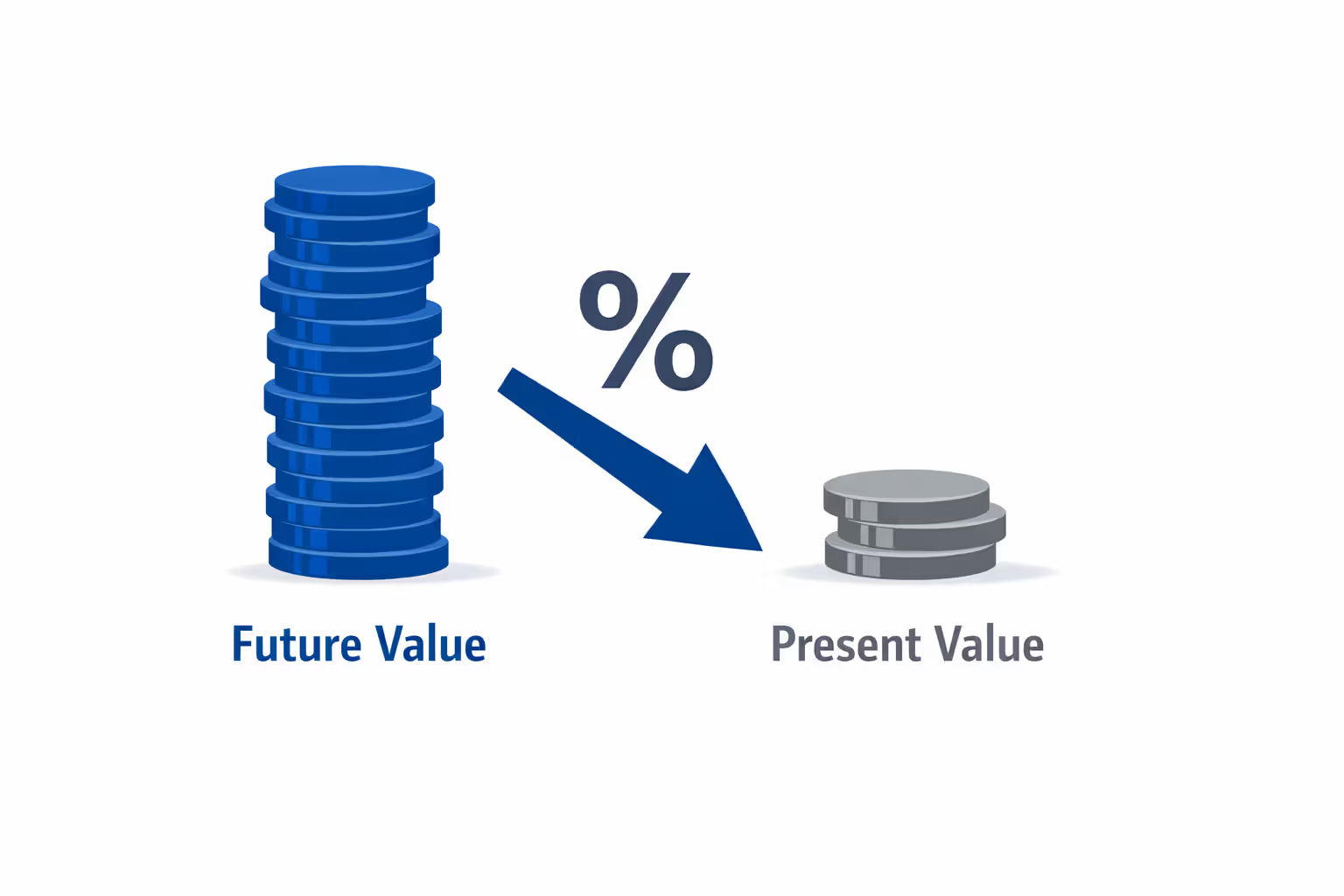
Here's where things get technical, but stay with me—this number directly controls how much cash lands in your account. The discount rate represents the buyer's profit margin combined with what it costs them to use their capital. Higher discount rate equals lower offer for you.
Apply a 10% discount rate to $100,000 in payments coming in five years, and you're looking at roughly $62,092 in today's dollars. Bump that rate to 15%? Your present value crashes to $49,718. That five-point swing just cost you $12,374.
What you're getting paid and when determines which discount rate buyers apply. Shorter payment windows usually qualify for lower rates (which benefits you). A three-year payout might get quoted at 9-11%, while a 25-year schedule could face 14-18% rates. Buyers demand bigger returns when their money's locked up longer.
Author: Andrew Halvorsen;
Source: avayabcm.com
Market Conditions and Buyer Competition
The structured settlement purchasing industry isn't static. When you've got multiple companies hungry for inventory, discount rates come down and your offers improve. Periods when buyers have extra capital sitting around with fewer opportunities? That's when you benefit from them competing against each other.
Where you live creates different levels of buyer interest. Some companies completely avoid states where approval processes drag on or consumer protection laws increase their transaction costs. Fewer active buyers in your state means less competition, which can translate to worse offers.
Broader economic conditions play a significant role. When interest rates climb, buyers can earn better returns parking money elsewhere, making them pickier about structured settlements. Low-interest environments tend to improve what you'll get offered since buyers are hunting for higher yields.
How to Calculate What You'll Actually Receive for Your Settlement
Figuring out your settlement payment worth starts with writing down every single remaining payment—the amount and exact date you're supposed to receive it. That's your payment schedule, and everything else builds from there.
Then you apply a discount rate to calculate present value. The formula looks like this: PV = FV / (1 + r)^n. Don't let the letters scare you. PV is present value (what it's worth now), FV is future value (the payment amount), r is the discount rate, and n is how many periods until you get paid.
Here's a real example: You've got a single $10,000 payment arriving in three years, and buyers are using a 12% discount rate. The math works out to $10,000 / (1.12)^3 = $7,117.80. Do that calculation for every payment you have left, add up all those present values, and you've got your total settlement worth before anyone takes out fees.
Check out how discount rates hammer a $100,000 structured settlement depending on your payment timeline:
| Payment Period | 8% Discount Rate | 10% Discount Rate | 12% Discount Rate |
| 5 years | $67,800 | $62,092 | $56,743 |
| 10 years | $46,032 | $38,554 | $32,197 |
| 15 years | $31,524 | $23,939 | $18,270 |
| 20 years | $21,455 | $14,864 | $10,367 |
These numbers assume you're getting equal payments annually. Your actual offer drops further once they subtract transaction fees, which usually run 1-3% of the purchase price.
Most buyers take out additional chunks for underwriting, legal review, and court approval costs. Start with a $50,000 present value calculation, and you might see an actual offer of $47,500 after they deduct $2,500 in fees. Always ask for itemized quotes breaking out the discount rate and every single fee separately.
5 Factors That Decrease Your Settlement's Buyout Price
1. Time Value of Money
A dollar in your hand today beats a dollar arriving five years from now. You could invest that immediate cash, knock out high-interest debt, or handle emergencies right away. Buyers understand this principle intimately, and they price it into every offer they make. The further out your payment schedule stretches, the harder this factor hits your buyout price. A 30-year settlement faces way steeper discounts than a five-year agreement carrying the same total dollar amount.
2. Transaction Fees and Costs
Most states require court approval, which costs buyers real money. They're paying attorneys to prepare petitions, show up at hearings, and make sure everything complies with state structured settlement protection acts. Those costs—usually running $1,500 to $4,000 per transaction—get subtracted from your offer. Buyers also eat underwriting expenses, title searches, and administrative costs that chip away at what they'll pay you while they're protecting their target profit margins.
3. State Regulations and Approval Complexity
Some states force buyers to disclose minimum discount rates, impose mandatory waiting periods, or require them to prove the sale actually helps you. These protections work in your favor as a consumer, but they jack up buyer costs and create timeline uncertainty. Transactions in states with streamlined approval processes often generate better offers than deals in places with extensive requirements. California, New York, and Florida have particularly detailed regulations that can affect what you're offered.

Author: Andrew Halvorsen;
Source: avayabcm.com
4. Payment Structure Complexity
Simple payment schedules get better valuations every time. If your settlement pays $1,000 monthly for ten years straight, buyers can calculate value and assess risk in their sleep. Complicated structures with payments that vary, cost-of-living adjustments, or contingent payments force them to do extra analysis. That uncertainty pushes buyers to apply higher discount rates or sometimes just walk away from the deal. Settlements carrying balloon payments, step-ups, or irregular schedules typically face discount rates running 1-3 percentage points higher.
5. Credit Risk and Issuer Strength
Who's on the hook to make your payments matters. Annuities issued by top-tier insurance companies (A+ or better ratings from A.M. Best) command premium prices. Lesser-known issuers or companies with lower ratings introduce default risk that buyers absolutely price into their offers. Structured settlement annuities carry strong legal protections, but buyers still dig into issuer financial strength. A settlement backed by a AA-rated insurer might get quoted at a 10% discount rate while identical payments from an A-rated company face 11-12% rates.
Getting an Accurate Structured Settlement Value Estimate
Getting a realistic valuation means giving potential buyers complete information upfront. Leave out key details, and you'll get preliminary quotes that drop substantially once buyers review your full documentation.
What Information Buyers Need
Buyers absolutely need your settlement agreement or annuity contract showing the complete payment schedule. This document spells out amounts, dates, and any special provisions affecting when and how much you get paid. Without it, buyers can only throw out rough estimates that rarely match what they'll actually offer.
The insurance company name and policy number let buyers verify your annuity exists and check the issuer's financial ratings. This verification protects everyone involved and enables the accurate risk assessment that drives what discount rate gets applied to your deal.
Your identification and contact information kicks off the underwriting process. Buyers verify you're actually the rightful payee and check for previous assignments or sales that might complicate things. Selling payments before doesn't disqualify you, but it affects which payments you still have available to sell.
Court approval from any previous sales matters big time. If you've already sold some payments, buyers need those court orders to figure out which payments you still own. Trying to sell payments you've already assigned wastes everybody's time and can trigger serious legal problems.
Red Flags in Lowball Offers
Discount rates pushing past 18% signal aggressive buyer pricing that's almost certainly undervaluing your settlement. Complex or long-term settlements can justify higher rates, but anything beyond 18% deserves serious skepticism and comparison shopping.
Pressure tactics scream predatory buyer. Legitimate companies give you time to review everything, encourage you to consult an attorney, and don't push for immediate decisions. Hear things like "this offer expires in 24 hours" or "we can only pay this price today"? That buyer's hoping you'll accept without shopping around.
Vague fee disclosures hide costs that'll reduce your net proceeds. Reputable buyers itemize their discount rate, transaction fees, and every other deduction. Offers that just state a lump sum without showing you the calculation prevent you from evaluating whether their rate's actually competitive.
Requests for upfront payments mean you're dealing with scammers. Legitimate structured settlement buyers never charge application fees, processing fees, or any costs before closing. They make their profit from the discount rate, not from fees you pay them.
Partial vs. Full Settlement Sales: Which Maximizes Your Value?
Selling just some of your payments instead of everything often delivers better financial outcomes. This comparison shows how partial sales let you raise cash now while keeping future income intact.
Partial sales let you grab cash without giving up all your future payments. Need $30,000 for a business opportunity but you're receiving $1,500 monthly for 15 years? Selling just five years of payments might generate the cash you need while preserving ten years of future income.
Here's a side-by-side comparison using a settlement paying $2,000 monthly for 15 years (total face value: $360,000):
| Sale Type | Payments Sold | Approximate Cash Received* | Payments Retained | Future Income Kept |
| 5-year partial | 60 payments | $95,000 | 120 payments | $240,000 |
| 10-year partial | 120 payments | $165,000 | 60 payments | $120,000 |
| Full sale | 180 payments | $210,000 | 0 payments | $0 |
*Based on 12% discount rate; your actual offers will vary
The five-year partial sale puts $95,000 in your pocket immediately while you keep $240,000 in future payments. After five years pass, your monthly income starts flowing again. This strategy works great for one-time expenses like education, medical bills, or home purchases.
Full sales make sense when you need maximum immediate capital or want to eliminate payment uncertainty completely. Entrepreneurs launching businesses, people relocating internationally, or anyone carrying high-interest debt might benefit more from liquidating their entire settlement.
Think about your age and overall financial situation. Younger recipients with decades of payments stretching ahead often benefit from partial sales that address current needs without wiping out long-term income security. Older recipients closer to their payment schedule's end might prefer full sales providing immediate capital for retirement planning.
Tax implications stay the same—structured settlement sales generally aren't taxable whether you sell partially or completely. However, what you actually do with the proceeds might trigger taxes. Using sale proceeds to fund a business creates different tax situations than just depositing the money in savings.

Author: Andrew Halvorsen;
Source: avayabcm.com
State-by-State Differences That Affect Settlement Worth
Every state except New Hampshire and Washington D.C. has enacted Structured Settlement Protection Acts requiring court approval for transfers. These laws create different processes that influence how quickly you get your funds and sometimes affect what offers buyers make.
Some states require buyers to disclose the discount rate in their court filings, creating transparency that protects you as the seller. Others mandate that judges independently determine whether the transfer actually serves your best interest, adding scrutiny that can delay approval but prevents exploitative transactions.
Waiting periods between filing and approval vary all over the map. Some jurisdictions schedule hearings within 20 days while others drag out to 45-60 days. Buyers factor these timelines into their offers since longer approval periods increase what it costs them to keep capital tied up.
A handful of states limit discount rates or require specific consumer disclosures. These protections generally help sellers by blocking the most aggressive pricing, though they might reduce how many buyers are willing to operate in those markets.
Court filing fees and legal costs differ by jurisdiction. Counties with higher filing fees see those costs passed along to sellers through reduced offers. Urban counties sometimes process transfers faster than rural ones, affecting transaction timelines.
Where you physically live matters less than where the original settlement was established and which state's courts approved it. The settlement's originating jurisdiction typically controls which laws apply to transfers, even if you've since moved across the country.

Author: Andrew Halvorsen;
Source: avayabcm.com
Frequently Asked Questions About Structured Settlement Values
Figuring out what your structured settlement's actually worth requires understanding discount rates, payment timing, and market factors creating that gap between face value and cash offers. Most sellers walk away with 40-70% of their remaining payments' nominal value, with shorter payment schedules and simpler structures commanding better prices.
Calculate your settlement's approximate worth by applying 10-14% discount rates to each future payment, then subtract another 2-4% for transaction costs. This rough estimate helps you evaluate whether buyer quotes reflect fair market value or represent lowball attempts hoping you won't shop around.
Getting multiple quotes from competing buyers remains your strongest strategy for maximizing value. Discount rate differences of just 2-3 percentage points can mean thousands of dollars staying in your pocket versus going to the buyer. Consider partial sales addressing immediate needs while preserving future income security for later years.
Court approval requirements protect you from predatory offers but add 30-60 days to the transaction timeline. Use this mandatory waiting period to verify you're making the right financial decision, ideally with guidance from a financial advisor who actually understands structured settlements and secondary market transactions.
Your settlement's worth ultimately comes down to what buyers will pay given today's market conditions. Armed with knowledge of valuation factors, calculation methods, and warning signs in lowball offers, you can negotiate effectively and make informed decisions about whether selling actually serves your financial goals.