Top view of a desk with IRS tax forms 1099 and 1040, a calculator, a pen, a settlement check envelope, and a laptop showing the IRS website
How to Report Structured Settlement Tax Reporting on Your IRS Filing

Content
Tax season catches most structured settlement recipients off guard. You've been cashing checks or receiving direct deposits for months—maybe years—without giving taxes much thought. Then April rolls around, and you're staring at your computer screen wondering: "Do I report this? Where does it go? Will the IRS come after me?"
Here's the problem: people think structured settlements work like lottery winnings or inheritance. They don't. A woman receiving $2,500 monthly from a car accident settlement has zero tax liability. Her neighbor getting the exact same amount from an employment lawsuit? She'll owe federal and state taxes on every dollar. Same payment schedule, completely opposite tax treatment.
What makes your settlement taxable or tax-free comes down to one thing—what the money replaces. Get this wrong on your return, and you're either handing the IRS money you don't owe or setting yourself up for penalty notices and potential audits.
Are Structured Settlement Payments Taxable Income?
The IRS splits settlements into two worlds. Cross the line between them, and your tax bill changes by thousands of dollars annually.
Physical Injury vs. Non-Physical Injury Settlements
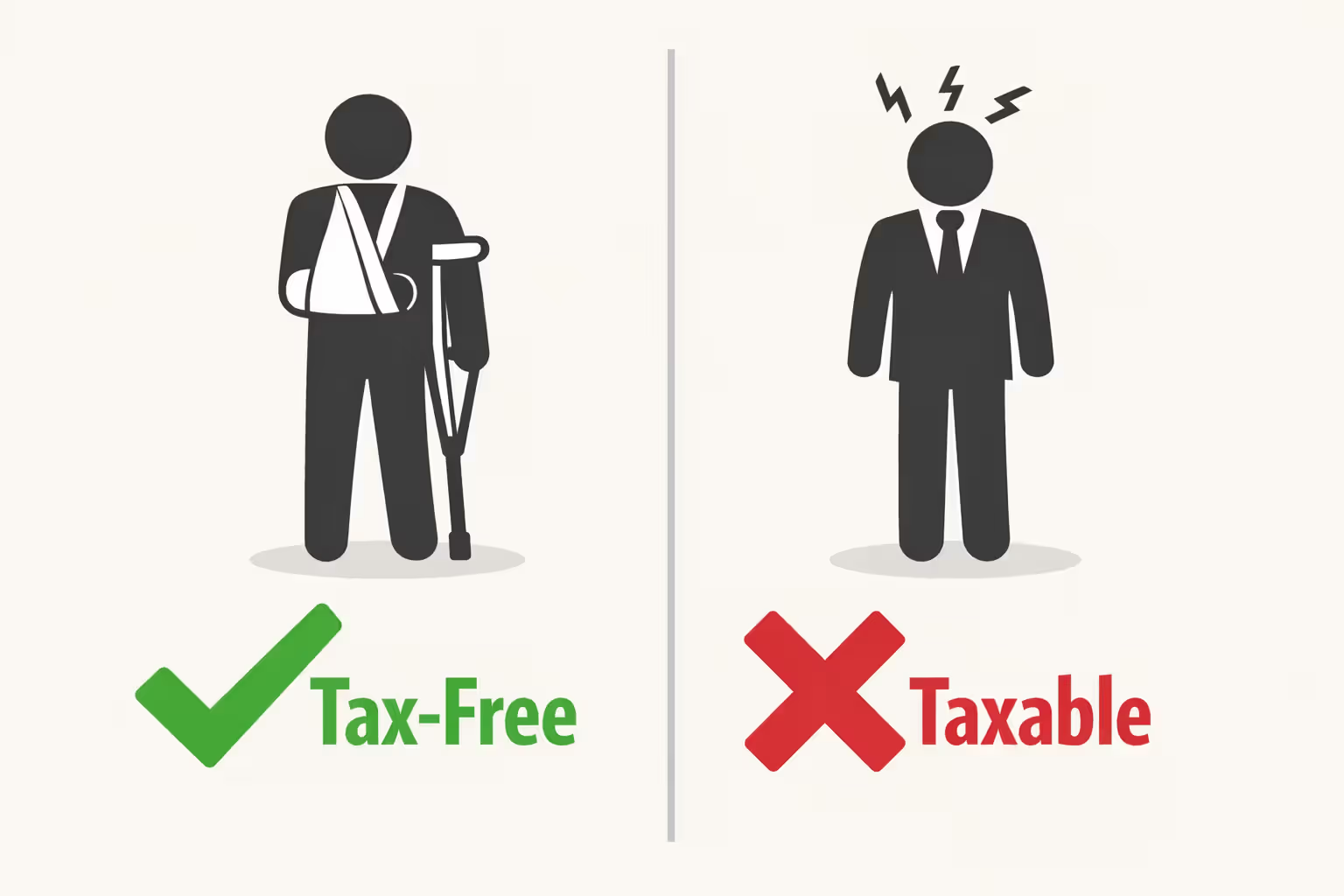
Internal Revenue Code Section 104(a)(2) creates a safe harbor for anyone compensated for physical injuries or sickness. Break your back in a construction accident? Tax-free. Lose your leg to a defective product? Tax-free. Develop chronic pain from surgical errors? Tax-free.
These settlements cover more than just medical bills. You won't pay taxes on money replacing your wages while you recovered, compensating you for ongoing treatment, or acknowledging your pain. The physical component makes everything attached to it tax-exempt.
The confusion starts when emotional or psychological harm enters the picture. Got diagnosed with PTSD after a car accident that broke three ribs? Those payments stay tax-free because the emotional distress flows from physical injuries. But settle a sexual harassment case where you developed severe anxiety—with documented therapy and medication—yet suffered no physical injury? The IRS wants its cut of every payment.
Author: Christopher Vaughn;
Source: avayabcm.com
This gets messy fast with workplace cases. Say you're 58 years old, fired illegally, and you settle for $400,000 paid over eight years. The settlement agreement breaks it down: $280,000 for lost wages, $100,000 for emotional distress, and $20,000 for punitive damages. You'll pay ordinary income tax rates on the wages portion—could be 22%, 24%, or higher depending on your bracket. The emotional distress money? Also taxable since it doesn't stem from physical injury. The punitive damages? The IRS taxes those regardless of the underlying claim, even in physical injury cases.
Many settlement agreements avoid specifying these breakdowns. Lawyers negotiate a lump sum, everyone signs, and nobody thinks about taxes until next year. Without clear allocation in your agreement, you're left guessing how much you owe—and the IRS doesn't accept "I didn't know" as an excuse.
When Structured Settlements Become Taxable Events
A tax-free settlement can transform into a tax nightmare the moment you modify it. Stick with the original terms? You're fine. Start making changes? You've opened Pandora's box.
Selling future payments creates immediate consequences. Your physical injury settlement—$4,200 monthly for twelve more years—stays tax-free as long as you receive it as agreed. Sell seven years of payments to a factoring company for $250,000 today, and you've just triggered capital gains reporting. The transaction itself becomes taxable even though the underlying settlement wasn't.
Interest income trips up people constantly. Older structured settlements sometimes include interest components alongside the principal payments. You might receive $2,800 monthly, with $2,650 representing your settlement and $150 being interest earned. That $150 monthly ($1,800 annually) gets reported on Form 1099-INT, and you'll owe taxes on it despite the main settlement staying exempt.
Attorney contingency fees create another trap. Your lawyer takes 40% off the top before structuring your $600,000 employment settlement—you net $360,000. Sounds simple, except you might receive a 1099 showing the full $600,000. Before 2018, you could deduct the $240,000 in legal fees as a miscellaneous itemized deduction. The Tax Cuts and Jobs Act killed that deduction for most cases. Now you're taxed on money you never touched, and there's no offsetting deduction. This catches people with five-figure surprise tax bills.
IRS Forms Required for Structured Settlement Recipients
The forms that arrive in January—or don't arrive—determine whether you're reporting correctly or walking into an IRS mismatch notice.
| Form Name | Situations Requiring This Form | Information Shown on Form | Correct Reporting Location | Tax Treatment |
| 1099-MISC | Taxable settlements exceeding $600 in the calendar year | Other income, legal settlements, non-employee pay | Schedule 1 Line 8z for settlements; Schedule C when business-related | Taxed as ordinary income at your marginal rate |
| 1099-INT | Settlement accounts generating interest earnings | Interest from settlement funds or annuity accounts | Schedule B when total interest tops $1,500; otherwise directly on 1040 Line 2b | Ordinary income; no special rate |
| 1099-R | Unusual situations where settlement went into retirement accounts | Retirement plan distributions | Lines 4a and 4b of Form 1040 | Taxed as retirement income; early withdrawal penalties may apply |
| W-2 | Employment-related settlements characterized as back wages | Standard wage reporting including withholding | Line 1 of Form 1040 | Subject to federal income tax plus Social Security and Medicare taxes |
Most people with physical injury settlements never see any of these forms. The annuity company or qualified assignment company sends your monthly payment with zero tax reporting because Section 104(a)(2) excludes the payment from income. No 1099 arrives because there's nothing taxable to report. This doesn't mean you're hiding income—it means the law exempts it entirely.
Problems surface when forms arrive unexpectedly or fail to arrive when they should. You settled an employment dispute, receive $8,400 annually in monthly payments, and January 31 comes and goes without a 1099. By February 15, you should be on the phone with your settlement administrator. The IRS already has their copy. File your return without reporting that income, and you'll receive a CP2000 notice in about 18 months proposing additional taxes, penalties, and interest.
Even worse: receiving a 1099 for a physical injury settlement. Mistakes happen—administrators code payments incorrectly, companies merge and lose historical data, or someone checks the wrong box. Don't ignore it. The IRS computer matches every 1099 against tax returns automatically. Leaving it off without explanation flags your return instantly.
How to Report Settlement Annuity Payments on Your Tax Return
Your settlement annuity tax filing approach depends on whether you're reporting anything at all, and if so, what category it falls into.
Step-by-Step Filing Instructions by Settlement Type
Physical injury settlements with Section 104(a)(2) exclusion: Nothing goes on your return. Your Form 1040 treats these payments as if they don't exist. Keep your settlement agreement in your permanent files showing the physical injury basis, but don't enter the payments anywhere. Exception: If you mistakenly receive a 1099, attach a statement to your return explaining that IRC Section 104(a)(2) excludes these payments from gross income due to physical injury or sickness. Reference the settlement date and case details. Don't report the income amount—just explain why you're not reporting it despite the form.
Non-physical injury settlements generating a 1099-MISC: The amount in Box 3 (labeled "other income") goes on Schedule 1, Line 8z. In the description field, write something specific like "Legal settlement - employment discrimination." Generic descriptions raise questions. If the amount appears in Box 1 as non-employee compensation, you face a trickier decision. Schedule C treatment subjects you to 15.3% self-employment tax on top of regular income tax. That extra 15.3% applies to the first $160,200 (2023 figure, adjusted annually). Report on Schedule 1 instead if you can demonstrate the settlement doesn't constitute business income—you'll need solid reasoning since the IRS assumes Box 1 amounts involve self-employment.

Author: Christopher Vaughn;
Source: avayabcm.com
Employment cases reported on W-2: These flow to Line 1 of your 1040 exactly like regular wages. Your former employer should have withheld federal income tax (Box 2), Social Security tax (Box 4), and Medicare tax (Box 6). Verify these numbers match what you actually had withheld. Employment settlements structured as back wages sometimes compress multiple years of income into one year's W-2. You could receive $180,000 representing three years of lost wages, but it all gets taxed in the year paid. You lose the lower brackets you would have used across three years—income averaging disappeared decades ago. This alone can cost you $15,000 to $25,000 in extra taxes.
Documenting Periodic vs. Lump-Sum Distributions
Periodic payments matching your original settlement agreement rarely cause documentation headaches. You get $1,875 on the 15th of every month. Come tax time, you total twelve payments to get $22,500 annual income (if taxable). Save your payment confirmations and direct deposit records, but reporting stays straightforward.
Lump-sum distributions require more attention. Accelerated payments, commuted benefits, or settlement buyouts each carry different implications. If your annuity company became insolvent and the state guaranty association paid you a lump sum to close out your claim, the tax character doesn't change. Your tax-free physical injury settlement remains tax-free even when paid as an emergency lump sum rather than monthly payments.
Contrast that with choosing to sell. You voluntarily sell $150,000 in future payments to a factoring company for $95,000 cash today. That's a property sale. You're disposing of a capital asset—your right to receive future payments. Even though your original settlement was tax-free, this transaction generates reporting requirements. The $95,000 appears on a 1099-MISC from the factoring company. You'll calculate your basis (often zero), subtract it from what you received, and report the difference as capital gain. Short-term or long-term treatment depends on how long you held the payment rights before selling.
State structured settlement protection acts require court approval before these sales go through. Skip the court process, and you risk the IRS's 40% excise tax under Section 5891. That penalty targets factoring companies, but it signals the transaction might not legally transfer your payment rights—meaning you could still owe the original payments even after spending the buyout.
Common Tax Reporting Mistakes That Trigger IRS Audits
Errors in structured settlement reporting follow predictable patterns. Watch for these common problems:
- Treating physical injury payments as taxable income when they're not: Seeing $45,000 in annual settlement payments makes some people nervous about not reporting them. They enter the amount on their tax return "just to be safe." Now they're overpaying by thousands and face an uphill battle getting refunds because the IRS processes returns as filed. Always confirm your settlement's legal nature before reporting anything.
- Applying the wrong tax treatment to mixed settlements: Your $275,000 settlement includes $200,000 for physical injuries from a workplace accident and $75,000 for age discrimination regarding the termination that followed. Only the $200,000 escapes taxation. The $75,000 age discrimination portion gets taxed as ordinary income. Many recipients see one settlement check and treat it all the same way—either all taxable or all excluded. The allocation matters enormously.
- Overlooking interest from pre-settlement accounts: Your physical injury settlement sat in an interest-bearing account for three months during appeals before being structured. That account earned $1,243 in interest. Section 104(a)(2) doesn't cover interest income—just the settlement itself. That $1,243 appears on Form 1099-INT, and you'll owe taxes on it even though the underlying settlement was tax-free.
- Mishandling attorney fee reporting: You settled a wrongful termination case for $250,000. Your attorney took $100,000 as a contingency fee, and you received $150,000. The defense attorney reports paying $250,000 to resolve the case. You get a 1099 for the full amount. You report $150,000 (your net) and skip the other $100,000 because you never received it. The IRS sees a $100,000 discrepancy. Before 2018, you'd deduct the $100,000 in attorney fees. That deduction vanished for most cases, but the income reporting requirement didn't. You're stuck reporting the full $250,000 and paying tax on $100,000 you never saw (unless your case qualifies for above-the-line attorney fee deductions—employment discrimination and whistleblower claims sometimes do).
- Picking the wrong line or schedule on Form 1040: Your 1099-MISC shows non-employee compensation in Box 1. You report it as "other income" on Schedule 1 Line 8z to avoid self-employment taxes. The IRS computers flag the mismatch between Box 1 treatment (expecting Schedule C) and Schedule 1 reporting. This alone won't trigger an audit, but it starts your return down the examination path.
- Failing to report factored settlement transactions: You sold five years of future payments to RSL Funding for $85,000. RSL issues you a 1099-MISC. You think RSL handles the tax reporting because they bought the payments. Wrong. RSL reports what they paid you. You must report receiving that payment and calculate any gain. Recipients who ignore this completely often face notices demanding taxes on the full $85,000 with zero basis offset.
- Assuming state taxes mirror federal treatment: In most states, they do. California, for instance, follows the federal physical injury exclusion. But some states deviate. Assuming your state matches federal treatment without checking costs people every year when state tax notices arrive demanding payment on "excluded" income.
- Thinking the $600 threshold means you don't report it: Taxable income gets reported regardless of amount. The $600 threshold determines the payor's obligation to issue a 1099—not your obligation to report income. Receive $575 in taxable settlement income without a 1099? You still owe taxes on it and must report it.

Author: Christopher Vaughn;
Source: avayabcm.com
Special Reporting Rules for Sold or Transferred Structured Settlements
Selling your settlement payments opens a completely different reporting chapter. The rules governing factored payments diverge sharply from rules for receiving payments under your original agreement.
Selling constitutes disposing of property. The tax code treats your right to future payments as a capital asset. Sell it, and you're reporting a capital transaction on Schedule D. Your basis equals what you paid for the asset—typically nothing in settlement cases since you didn't purchase the right to receive payments. Sell $145,000 in future payments for $92,000, and you've got $92,000 of capital gain (assuming zero basis). Whether it's short-term or long-term depends on how long you held the payment rights. Settlement recipients usually have long-term holding periods, qualifying for preferential capital gains rates (0%, 15%, or 20% depending on your income).
IRC Section 5891 throws a wrench into the entire factoring industry. This provision imposes a 40% excise tax on any factoring company that purchases structured settlement payment rights without obtaining court approval as required by state structured settlement protection laws. Every state has these laws. They require judicial review before factoring transactions finalize, protecting recipients from predatory practices.
The 40% penalty makes non-compliant transactions financially impossible for factoring companies. A company buying $100,000 in payment rights without court approval faces a $40,000 penalty—wiping out any profit margin. Legitimate companies won't touch deals lacking proper court orders. Those that do often operate on shaky financial ground, meaning your payments might disappear even after you've sold them and spent the money.
Section 5891's 40% penalty was Congress's way of stopping predatory factoring companies, and it works—sort of. Legitimate companies follow the court approval requirements religiously, but that slows the process down. Recipients get impatient, and unscrupulous operators promise fast money without court hassles. What people don't realize is selling without court approval might not legally transfer their payment rights. The factoring company faces the penalty, but recipients can end up in situations where they've spent the lump sum, the transaction gets invalidated, and they still owe taxes on money they no longer have. I've watched three clients go through this nightmare. The transaction unwinding came years later—after they'd spent everything and couldn't possibly repay
— Jennifer Martinez
Factoring companies issue Form 1099-MISC reporting lump sums paid to purchase your payment rights. That form shows you received money—it doesn't explain the entire tax picture. You need to determine your gain, apply the correct holding period for capital gains treatment, and verify the sale followed proper legal channels. Characterizing the transaction as something other than a sale—calling it a loan or an advance—rarely works. The IRS examines the transaction's substance. Permanently transfer payment rights for a lump sum? That's a sale no matter what label the contract uses.
Record-Keeping Requirements for Settlement Payment Documentation
The IRS generally audits returns within three years of filing. Substantially understate income by 25% or more, and that window extends to six years. For settlements, keep records beyond the minimum statutory period.
Hold onto these documents permanently:
- Your complete settlement agreement: This establishes whether Section 104(a)(2) exclusion applies. Twenty years from now, if the IRS questions your return, this agreement proves your settlement compensated physical injuries. Without it, you're arguing from memory against IRS records.
- Qualified assignment documentation: If your settlement used a qualified assignment company to maintain tax-free status, these papers show the proper structure. Assignments prevent constructive receipt problems that could make tax-free settlements taxable.
- Annuity contracts and payment schedules: These detail your payment terms, amounts, and timing. They prove what you were supposed to receive versus what actually arrived—critical if payment disputes arise.
Keep these records for at least seven years:
- Annual statements from annuity companies: These confirm what you received each year. If the IRS claims you underreported, these statements provide your defense.
- Every 1099 form regardless of accuracy: Got a 1099 you think is wrong? Keep it along with your documentation explaining why. Throwing it away means you can't prove you received it or addressed the discrepancy.
- Court orders approving any payment sales: These prove you followed Section 5891 requirements. Without them, you can't demonstrate the transaction was legally valid.
- All correspondence with settlement administrators: Email trails resolve disputes about payment amounts, schedule changes, or administrator errors that affect your tax reporting.
Maintain for at least three years:
- Filed tax returns showing settlement reporting decisions: Keep copies of every return where you reported settlement income or documented why payments weren't reported.
- Bank statements showing settlement deposits: Proof you received specific amounts on specific dates becomes crucial if payment amounts are disputed.
Create a dedicated settlement folder—physical or digital. Direct deposits for settlement payments should have clear descriptions. Bank statements showing "ACH deposit" with no identifying information prove very little if questions surface during an audit. Contact your bank to add descriptions like "Settlement payment - ABC Annuity Co." These small details matter when reconstructing history years later.
When your settlement administrator changes—common when insurance companies sell business lines or annuity providers merge—immediately request written confirmation of your payment schedule and terms from the new company. Transitions create documentation gaps where records disappear. Get everything in writing during the handoff.

Author: Christopher Vaughn;
Source: avayabcm.com
Frequently Asked Questions About Structured Settlement Tax Reporting
Structured settlement tax reporting boils down to identifying what your settlement compensated and how you've received or modified those payments. Physical injury settlements walk through tax season untouched by the IRS—no reporting, no taxes. Employment settlements and non-physical injury cases generate tax obligations identical to receiving regular paychecks.
The forms landing in your mailbox—or not landing there—reveal what the IRS already knows about your payments. Report tax-free physical injury settlements as income, and you're voluntarily overpaying taxes you'll struggle to recover. Ignore taxable settlement payments, and you're inviting penalty notices, interest charges, and possible audits.
Selling future payments transforms the entire tax picture. You can convert tax-free income streams into taxable capital gains while triggering penalty taxes if you skip required court approvals. The quick cash looks appealing until you calculate the tax cost and discover you've locked in a terrible deal.
Maintain complete records of your settlement agreement, payment history, and every form you receive or should have received. When you're uncertain whether your specific settlement requires reporting, spend $300 to $500 consulting a tax professional who handles settlement taxation regularly. That cost is nothing compared to penalties and interest from incorrect reporting—or the stress of defending an IRS audit you could have prevented with proper documentation and advice before filing.