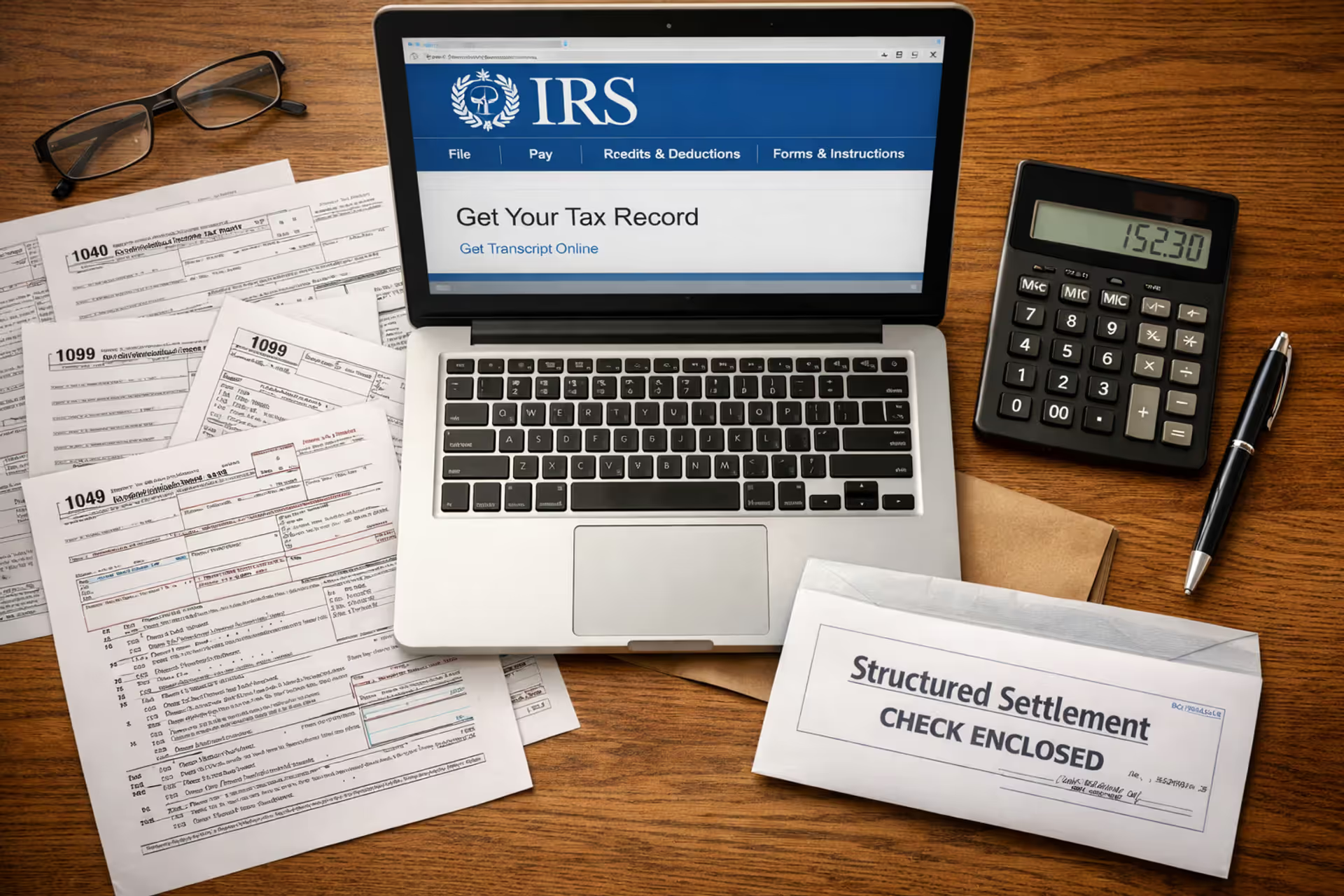
A desk with an opened envelope containing a check, IRS tax forms, a calculator, dollar bills, and a pen, with scales of justice blurred in the background
Structured Settlement Capital Gains Tax Guide

Content
Millions of Americans collect regular checks from structured settlements—usually monthly payments stretching over years or decades from personal injury cases. These payments arrive tax-free, which is great. But life happens. You need $80,000 now for a medical emergency, house down payment, or business investment. So you Google "sell my structured settlement" and find companies eager to buy your future payments.
Here's where people get blindsided. Just because your monthly checks don't generate tax bills doesn't mean converting them to a lump sum stays tax-free. The assumption that "tax-free in means tax-free out" costs people serious money—sometimes 15% to 20% of their sale proceeds vanishing to capital gains taxes they didn't budget for.
Whether liquidating your payment rights triggers tax liability isn't straightforward. It hinges on where your settlement came from, how the sale transaction works, and what the IRS considers a "transfer of property rights." Get these details wrong, and you might spend your entire lump sum before discovering you owe the IRS $25,000.
How the IRS Classifies Structured Settlements for Tax Purposes
Let's start with why your regular settlement checks don't create tax bills. Internal Revenue Code Section 104(a)(2) says damages you receive for personal physical injuries or physical sickness—whether paid immediately or over time—don't count as taxable income. Congress wrote this rule specifically to keep injury victims from losing part of their compensation to taxes.
That's the structured settlement tax classification foundation. Got hit by a drunk driver and settled for $500,000 paid over 20 years? Tax-free. Suffered permanent injuries from medical malpractice? Those monthly payments don't go on your 1040. Hurt your back at work and received workers' comp structured over ten years? Also excluded from taxable income under a related code section.
But qualifying for this sweet tax treatment requires meeting specific criteria. Your settlement must stem from physical bodily harm or sickness. That car accident or slip-and-fall injury qualifies. The insurance company funding your annuity doesn't pay taxes on investment growth, and you don't pay taxes receiving distributions.
Now here's what trips people up. Employment lawsuits? Taxable. Breach of contract cases? Taxable. Emotional distress claims without accompanying physical injury? Taxable. And punitive damages? Always taxable, even if they're tacked onto an otherwise qualifying physical injury case.
Say you settled a personal injury lawsuit for $400,000—$350,000 for your injuries and $50,000 in punitive damages to punish the defendant. Only that $350,000 portion gets tax-free treatment. The punitive $50,000 gets reported as income.
Author: Olivia Carmichael;
Source: avayabcm.com
When you receive payments under the original settlement terms, everything's straightforward. Your check arrives, you spend it, and come tax season you don't report it anywhere. The insurance company doesn't send a 1099 form. Your accountant doesn't ask about it. This continues indefinitely—until you decide to sell payment rights to a factoring company.
Does Selling Your Structured Settlement Trigger Capital Gains Tax?
Receiving your scheduled payments versus selling your future payment rights are completely different transactions in the IRS's eyes. One is simply collecting compensation Congress decided should remain untaxed. The other? That's where things get complicated.
When factoring companies buy structured settlement rights, here's the deal they're offering: we'll pay you $70,000 today for the right to collect your next $120,000 in payments over six years. That $50,000 gap? That's their profit margin plus the time-value-of-money discount. You get cash now but give up significantly more later.
The tax question centers on whether you've sold a capital asset. If you sell stock you bought for $10,000 and receive $70,000, you've got a $60,000 capital gain. Simple. But what happens when you sell rights to receive payments you never purchased in the first place?
The Difference Between Assignment and Sale
Lawyers use "assignment" when you transfer your contractual rights to another party. "Sale" means exchanging property for money. In structured settlement transactions, both terms often describe the same deal, but tax consequences depend on economic substance rather than vocabulary choices.
What matters is what you're actually transferring. Your right to collect future payments is a form of property. You're conveying that property to a factoring company for cash. Traditional tax principles say selling property generates gain equal to sale proceeds minus your cost basis in that property.
Here's the problem for most settlement holders: your basis is zero. You didn't buy the right to these payments—you received them as injury compensation. Zero basis means the entire lump sum you receive potentially becomes taxable gain.
When Capital Gains May Apply to Settlement Sales
Nobody knows exactly how structured settlement capital gains should be taxed, which sounds crazy but it's true. The IRS hasn't issued clear regulations specifically addressing whether selling these payment rights produces capital gains, ordinary income, or somehow stays tax-free under that original Section 104(a)(2) exclusion.
Tax professionals argue three different positions. Some say you're just accelerating receipt of amounts that would've arrived tax-free anyway, so the sale shouldn't create taxes. Others argue you're definitely selling property with zero basis, which absolutely creates capital gain. A third group suggests the discount you accept represents the buyer's income, not yours, so maybe nothing's taxable to you.
Courts have weighed in on specific cases without settling the broader question. Several rulings found that lump sums received for structured settlement rights didn't qualify for the 104(a)(2) exclusion, implying they're taxable. But each case involved unique circumstances that limit how broadly those holdings apply.
Here's my take after reviewing dozens of these transactions: assume you'll face potential capital gains exposure if you sell rights from a personal injury settlement. Treat the lump sum you receive as long-term capital gain (assuming you've held the rights over a year). Plan for the tax bill. If it turns out you don't owe taxes, great—but don't bet your financial future on that outcome.
Common Tax Treatment Scenarios When Liquidating Settlement Payments
Different settlement types create different tax situations when you liquidate them. This chart breaks down the most common scenarios, though your specific facts might create different results:
| Settlement Origin | Tax Status While Receiving Payments | What Happens When You Sell | Will You Owe Capital Gains? | How to Report It |
| Car accident settlement (physical injury) | Completely tax-free under 104(a)(2) | Gray area—possibly taxable as capital gain | Probably yes, with sale proceeds minus zero basis creating the gain | Use Form 8949 and Schedule D if reporting as capital gain; definitely get professional advice first |
| Workers' comp structure (physical injury) | Excluded from income under 104(a)(1) | Parallel to personal injury situations | Yes, using same logic as regular injury settlements | Same forms as above if treating as capital asset sale |
| Discrimination lawsuit settlement | You already paid income tax on the original amount | Capital gain on any appreciation since you received the settlement | Yes, but only on growth beyond what you originally received after taxes | Calculate remaining basis carefully, then report on Form 8949 and Schedule D |
| Punitive damages paid over time | Treated as ordinary income each year | Selling creates capital gain on difference between sale price and remaining basis | Yes, though basis calculation gets tricky | You'll need Form 8949 and Schedule D with proper basis documentation |
| Lottery winnings annuity | Ordinary income annually | State laws vary, but generally capital gain treatment on sale | Yes, and basis calculation can get extremely complex | Form 8949, Schedule D, plus potentially state-specific forms depending where you live |
Real people make these decisions every day. Take Sarah, who got $600,000 from a 2014 medical malpractice case structured as $3,000 monthly for 20 years. She's collected ten years of payments. Then her daughter needs emergency surgery not covered by insurance. Sarah sells her remaining decade of payments—worth $360,000 in total—to a factoring company for $205,000.
Those monthly checks came tax-free for ten years under 104(a)(2) rules. But selling the remaining payment rights potentially triggers capital gains. Her basis? Zero—she didn't purchase these rights. That entire $205,000 could be long-term capital gain, taxed at maybe 15% to 20% depending on her other income. She just created a $30,000 to $40,000 tax bill she didn't anticipate.
Compare that to Robert's situation. He structured a $250,000 employment discrimination settlement in 2017, paid income tax on the full amount that year, then bought an annuity with the after-tax proceeds to pay himself over fifteen years. His basis in the annuity equals what he paid for it. Selling remaining payments creates capital gain only on appreciation beyond that basis—a totally different calculation than Sarah's.
Partial sales create additional wrinkles. Sell just four years of payments while keeping the rest? You're allocating basis (if you have any) between the sold portion and retained portion. For personal injury settlements with zero basis, this doesn't change much—you still recognize gain on everything you receive. But for settlements where you had basis, improper allocation can inflate your tax bill.

Author: Olivia Carmichael;
Source: avayabcm.com
Calculating Your Tax Liability: Basis, Gains, and Reporting Requirements
Figure out what you'll owe by working through the math step by step. First, determine your basis in the payment rights you're selling. For most personal injury structures, this equals zero—you got the settlement as compensation, not through purchase.
Did you acquire rights differently? Maybe you inherited them, or received them in a divorce settlement, or bought them from another settlement holder. Then you need documentation proving that basis. Without records, the IRS assumes zero basis, which maximizes your taxable gain.
The gain calculation itself follows standard formulas: amount you received minus adjusted basis equals your taxable gain. "Amount received" means all cash plus fair market value of anything else you got. If the factoring company paid $65,000 cash and also paid off your $8,000 credit card debt, your amount received is $73,000.
How long you've held the rights determines whether gains are short-term or long-term. Hold them over one year before selling? Long-term capital gain, taxed at 0%, 15%, or 20% depending on your total income. Under one year? Short-term gain, taxed as ordinary income at your regular tax rate—potentially 22%, 24%, or higher.
Most structured settlement sales involve long-term holding since you typically receive settlements years before selling rights. That's good news—those preferential long-term rates beat ordinary income rates. Someone in the 24% bracket pays just 15% on long-term capital gains, saving 9% on every dollar of gain.
Reporting this to the IRS requires proper forms. If you're treating the sale as capital gain, use Form 8949 to list the transaction details, then transfer totals to Schedule D attached to your Form 1040. You'll document when you got the rights, when you sold them, your basis, and sale proceeds.
Will the factoring company send you a 1099? Maybe. Industry practice varies wildly because nobody's certain how these transactions should be reported. Some companies issue 1099-MISC forms calling it "other income." Others send nothing, leaving reporting entirely to you. Don't assume no 1099 means no taxes—you must report taxable gains whether you receive a form or not.
State tax treatment adds another layer. Does your state have income tax? Many automatically follow federal capital gains treatment, so federal gain creates state gain. No income tax in your state? Then you're only dealing with federal taxes. A few states have unique rules for structured settlements or annuity transfers that diverge from federal treatment.
California, for instance, has stringent structured settlement transfer laws that might affect taxation. New York handles certain annuity transfers under rules that differ from IRS guidelines. Figure out your state's approach before assuming state tax mirrors federal treatment.
Quick guideline: if you're selling rights worth more than $20,000, get professional advice before signing anything. Spending $500 on a CPA consultation beats discovering you owe $8,000 in taxes you didn't budget for.

Author: Olivia Carmichael;
Source: avayabcm.com
Five Mistakes That Can Create Unexpected Tax Consequences
Mistake #1: Believing tax-free payments guarantee tax-free sales. This is the costliest error. Your monthly checks arrive without triggering taxes because of that 104(a)(2) exclusion for personal injury compensation. But selling rights to future payments transforms the transaction into a potential property sale. That original exclusion doesn't automatically extend to liquidating your payment stream. I've seen people sell $150,000 in future payments for $90,000, spend the whole amount, then get slammed with a $16,000 tax bill the next April.
Mistake #2: Skipping required court approval. Federal law requires judicial approval for structured settlement transfers—it's meant to protect you from predatory buyers. Completing a sale without this approval doesn't just break the law. It creates tax headaches. If the IRS decides your transfer was invalid, you might face arguments that you still constructively received payments, creating tax liability without the cash to pay it. Always follow legal procedures, which protect both your rights and your tax position.
Mistake #3: Treating documentation like it's optional. You need records showing when you acquired settlement rights, original settlement terms, the sale date, exact amount received, and transaction costs. Without this documentation, defending your tax position becomes nearly impossible three years later when the IRS sends a letter. Keep copies of everything: original settlement agreement, transfer agreement, court approval orders, correspondence with the buyer, wire transfer confirmations. Store them permanently.
Mistake #4: Forgetting that not all settlements qualify for 104(a)(2) treatment. Personal physical injury settlements get tax-free treatment. Employment disputes? Taxable. Emotional distress without physical symptoms? Taxable. Punitive damages? Always taxable. If your settlement wasn't from physical injury, different rules applied from day one. Selling rights to already-taxable payments creates different calculations than selling physical injury payment rights. Confirm your original settlement's tax status before making assumptions.

Author: Olivia Carmichael;
Source: avayabcm.com
Mistake #5: Choosing buyers based solely on offer amount. Some factoring companies operate in questionable ways. They might tell you sales are always tax-free when they're not. They might fail to issue required tax forms. They could provide terrible advice that lands you in trouble. Pick buyers with solid reputations, proper state licensing, and willingness to clearly discuss tax implications. Ask whether they'll issue a 1099 and what they tell the IRS about the transaction. Lowest purchase price doesn't matter if bad advice costs you thousands in penalties.
Working With Tax Professionals and Settlement Buyers
Settlement sales combined with tax law uncertainty make professional guidance valuable. A CPA experienced with structured settlements or a tax attorney can review your situation and deliver advice specific to your circumstances. Your regular tax preparer might lack specialized knowledge for these transactions.
When interviewing tax professionals, ask about their structured settlement experience. How many similar transactions have they handled? What position do they usually take regarding taxability? Can they provide references? Someone who's worked through multiple settlement sales understands the nuances and gray areas involved.
The biggest mistake I see is settlement holders completing sales before asking about taxes. By that point, you've locked in the transaction and lost opportunities to structure things optimally or decide whether selling makes sense after taxes. We had one client who sold $200,000 in future payments for $115,000, thinking it was tax-free. After federal and state capital gains taxes, he netted about $85,000—giving up $200,000 in payments. Had he called us first, he might have chosen a partial sale, explored alternative financing, or at minimum set aside tax money
— Jennifer Martinez
When dealing with factoring companies, ask direct questions about tax implications. Will they issue any 1099 forms? What tax position do their sellers typically take? Can they recommend tax professionals familiar with these deals? Legitimate companies acknowledge the uncertainty and encourage professional advice. Companies guaranteeing tax-free treatment or dismissing tax concerns probably don't have your best interests at heart.
Document everything throughout this process. Keep your original settlement agreement, all correspondence with the factoring company, the transfer agreement, court orders, and records showing exact amounts received. If the IRS questions your return years later, this documentation supports your position.
Think about timing relative to your other income. If you'll recognize capital gain, completing the sale in a year when your other income is lower might reduce the applicable tax rate. Someone earning enough to land in the 22% ordinary bracket pays 15% on long-term capital gains. Someone in the 12% bracket or below pays 0% on long-term gains. Strategic timing could save thousands.
Finally, remember uncertainty cuts both ways. The IRS might assert your sale produces taxable capital gain, but you also have reasonable arguments for non-taxability in certain situations. Tax professionals can help evaluate these arguments, choose defensible positions, and prepare proper disclosure if you're taking an aggressive stance. The goal isn't avoiding legitimate tax obligations—it's paying only what's legally required while properly reporting everything.
Frequently Asked Questions About Structured Settlement Taxes
Selling structured settlement payment rights creates complex tax considerations that catch many sellers off guard. While periodic payments from personal injury settlements arrive tax-free under IRC Section 104(a)(2), transferring rights to receive future payments potentially generates taxable capital gains. The IRS hasn't issued definitive guidance covering all scenarios, leaving uncertainty that makes professional advice essential before you act.
Before signing documents with a factoring company, understand potential tax consequences specific to your situation. Calculate likely tax bills, factor them into your decision, and set aside funds for tax payments if needed. Work with tax professionals experienced in this specialized area, and maintain thorough transaction documentation. Structured settlement capital gains taxes shouldn't surprise you months after you've already spent the money.