
Calculator on dollar bills next to magnifying glass and structured settlement agreement document on white desk
How to Calculate the Present Value of a Structured Settlement

Content
Most structured settlement recipients have no idea their payments are bleeding value with each passing year. When a factoring company waves a check in your face, you need to know whether they're offering fair value or hoping you can't do the math. Here's how to calculate exactly what those future payments are worth in cold, hard cash today.
What Present Value Means for Your Structured Settlement
Here's the fundamental question: Would you rather have $50,000 right now or the same amount delivered to your mailbox five years from today?
Anyone choosing the delayed payment is making a costly mistake. That $50,000 sitting in your account today could be working for you—earning interest, generating investment returns, or eliminating high-interest debt. Park it in a conservative bond fund averaging 5% annually, and you're looking at $63,814 in five years. The promised future payment can't compete with money you control immediately.
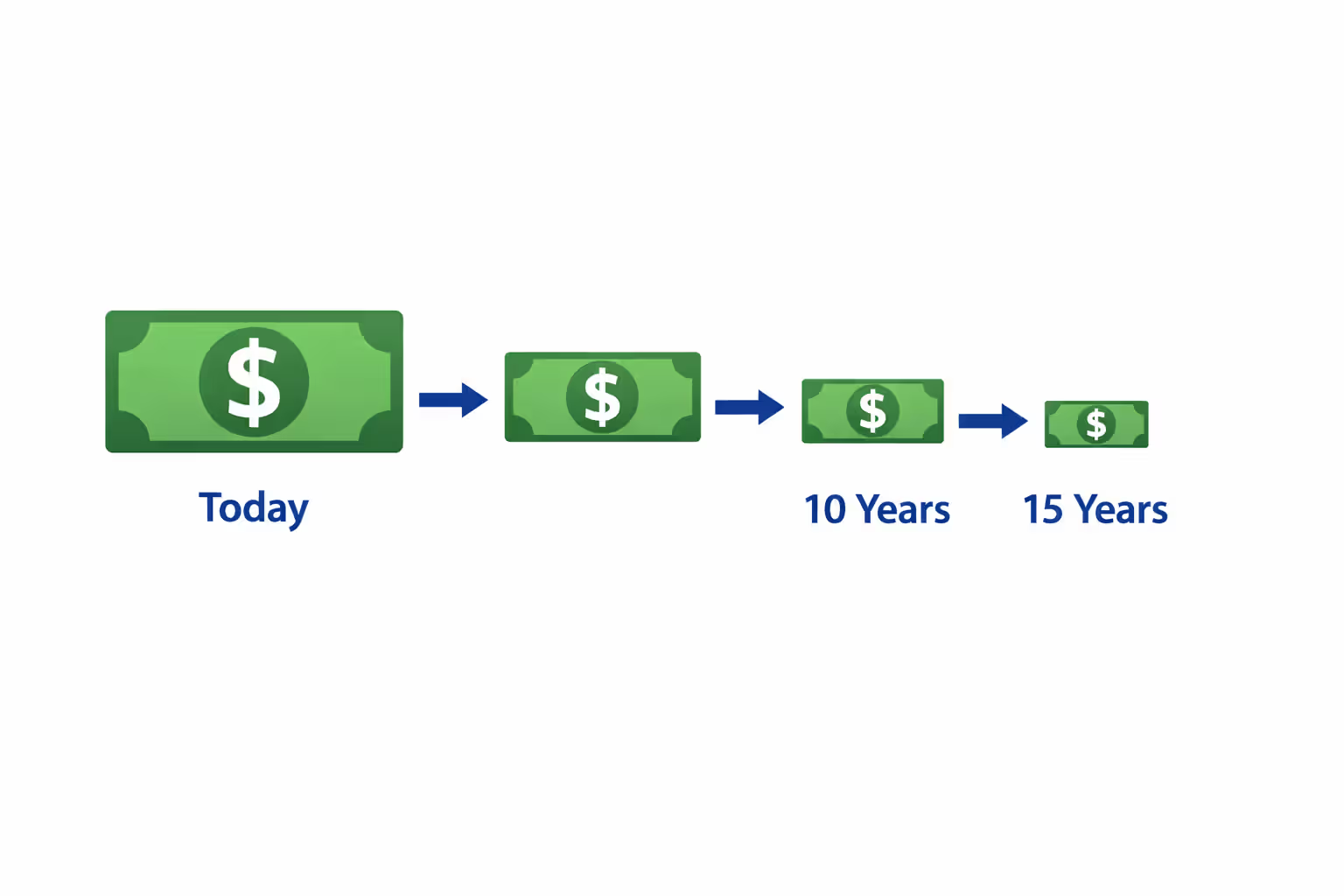
This principle—economists call it "time value of money"—explains why your structured settlement's total doesn't tell the real story. Let's say your settlement agreement promises $2,000 every month for the next fifteen years. Quick multiplication says that's $360,000 total. Except it's not, at least not in meaningful terms. Some of those dollars won't arrive for a decade or more, making them worth substantially less than the checks depositing next month.
The actual economic value—the present value—might land anywhere from $240,000 to $290,000, depending on how aggressively you discount future dollars. That discount rate is the mathematical lever moving everything. It works like compound interest running backward, shrinking future dollars to reflect their diminished current worth.
Author: Andrew Halvorsen;
Source: avayabcm.com
Consider a simple example: Your settlement includes a $100,000 payment arriving in exactly ten years. Calculate present value at 5%, and that future payment is worth $61,391 today. Bump the discount rate to 10%, and present value plummets to $38,554. Same payment, same timeline—but a $22,837 difference based purely on which discount rate you apply.
When factoring companies start circling with buyout offers, they're banking on you not understanding these calculations. Their offers cluster around present value (or below it), not your settlement's nominal total. Learn the math, and you'll spot lowball offers immediately.
The Mathematics Behind Settlement Present Value Calculations
Core Formula Components and Variables
Calculating present value for settlements with regular payments requires the annuity formula. Don't let the mathematical notation scare you off—it's actually straightforward once you identify what each piece represents:
PV = PMT × [(1 - (1 + r)^-n) / r]
Here's what you're plugging in: - PV represents present value—the number you're solving for - PMT equals your payment amount each period - r means discount rate per period (divide annual rate by payment frequency) - n counts total payments you'll receive
Some settlements skip the regular payments and promise a single lump sum years down the road. That situation needs a simpler formula:
PV = FV / (1 + r)^n
The FV here means future value (your lump sum amount), while n still represents the number of periods until you receive it.
Real-world settlements frequently blend both approaches. You might receive monthly checks for eight years, then a $75,000 balloon payment when everything wraps up. For hybrid structures like this, calculate each component's present value separately, then add your results together.
Imagine your settlement provides $1,500 monthly for ten years (that's 120 payments total), plus a $50,000 lump sum delivered at the end of year ten. You'd run the annuity formula for those monthly payments, calculate present value separately for that $50,000 lump sum, then combine both figures for your total present value.
Discount Rate Selection and Its Impact
Every other variable in your calculation is concrete and known. Payment amounts? Written in your settlement agreement. Number of payments? Simple counting. But choosing the right discount rate requires judgment calls that dramatically affect your final number.
Financial professionals typically look at these benchmarks: - Treasury bonds matching your settlement's timeframe provide a risk-free baseline (hovering around 4-5% currently for long-term bonds) - Investment-grade corporate bonds with similar duration run slightly higher (5-7% depending on credit quality) - Factoring company rates used in purchase offers climb much higher (frequently 9-18%, sometimes more)
Structured settlements backed by highly-rated insurance companies carry virtually zero default risk. You're getting those payments barring a catastrophic insurance company collapse, which state guaranty funds largely protect against anyway. That minimal risk suggests discount rates closer to Treasury yields or top-tier corporate bonds makes sense.
Factoring companies use dramatically higher rates—9% to 15% is common, sometimes pushing toward 18%. They're not making an objective assessment of financial value. Those inflated rates bake in their profit margins, operational costs, and return on capital expectations.
Small discount rate changes create massive value swings. Take a $200,000 settlement distributed over twenty years. At 5%, present value calculates to $148,775. Push that rate to 8%, and present value drops to $111,470. That's a $37,305 difference from a 3-percentage-point rate adjustment.
Step-by-Step Calculation Examples for Common Settlement Structures
Example 1: Basic Monthly Payment Stream
Sarah's settlement delivers $1,000 every month for fifteen years—180 total payments. She wants to value these payments using a 6% annual discount rate:
- PMT = $1,000
- r = 0.06 ÷ 12 = 0.005 (converting annual rate to monthly)
- n = 180
PV = 1,000 × [(1 - (1.005)^-180) / 0.005] PV = 1,000 × [(1 - 0.4066) / 0.005] PV = 1,000 × 118.68 PV = $118,680
Those 180 payments nominally total $180,000, but their present value lands at $118,680—roughly two-thirds of the face amount.
Example 2: Annual Payments Plus Final Lump Sum
Marcus receives $10,000 each year for five years, then collects an additional $75,000 when his fifth year arrives. He's calculating present value at 7%:
For the five annual payments: PV = 10,000 × [(1 - (1.07)^-5) / 0.07] PV = 10,000 × 4.100 PV = $41,000
For that $75,000 lump sum: PV = 75,000 / (1.07)^5 PV = 75,000 / 1.403 PV = $53,467
Combined total: $94,467
Marcus's settlement nominally delivers $125,000, but holds a present value of $94,467—about 76% of the nominal figure.
Example 3: Rate Sensitivity Demonstration
Let's examine how rate selection changes valuation for a settlement delivering $1,250 every quarter for twenty years. That's eighty payments totaling $100,000 nominally:
| Rate Applied | Calculated Present Value | Percentage of Nominal Total |
| 3% | $74,686 | 74.7% |
| 6% | $57,655 | 57.7% |
| 9% | $45,467 | 45.5% |
| 12% | $36,838 | 36.8% |
Look at that spread. Conservative 3% assumptions value this settlement at nearly $75,000, while aggressive 12% discounting slashes it to less than $37,000. We're talking about a $37,848 gap—more than one-third of total nominal value—based purely on rate selection. This explains why rate arguments get so heated during settlement valuations.
Five Critical Mistakes People Make When Valuing Their Settlements
Mistake 1: Accepting Factoring Company Rates as Objective Truth
When a factoring company values your settlement using a 14% discount rate, they're not providing neutral financial analysis. That 14% includes their profit margin, operating expenses, and desired return on invested capital. The company is pricing a business transaction, not delivering an academic assessment of financial worth.
True financial present value uses market-based rates reflecting actual risk. For settlements backed by stable insurance companies, that means 5% to 7% based on current Treasury and corporate bond yields. A company quoting 14% is effectively telling you they expect to make 7-9% profit by purchasing your payments. Many settlement holders make terrible deals because they compare buyout offers against inflated valuations calculated at these profit-loaded rates, making exploitative offers appear reasonable by comparison.
Mistake 2: Overlooking the Security Features of Structured Settlements
Your structured settlement likely carries ironclad guarantees most investments can't match. Major life insurance companies with AA or AAA ratings back the payments. State guaranty associations provide additional safety nets if the unthinkable happens. These protections substantially reduce risk.

Author: Andrew Halvorsen;
Source: avayabcm.com
Lower risk should translate to lower discount rates in your valuation. Yet many recipients calculate present value using rates appropriate for speculative investments carrying significant default risk. A guaranteed payment stream from a highly-rated insurer deserves a discount rate much closer to Treasury bonds than junk bonds. Ignoring these security features means applying inappropriately high discount rates that undervalue your settlement by tens of thousands of dollars.
Mistake 3: Assuming Payment Timing Doesn't Matter
Standard present value formulas assume payments arrive at each period's end. Your December payment? The formula treats it like it's arriving December 31st. But many settlements pay at the beginning of each period instead—your January payment hits January 1st, not January 31st.
That's called an "annuity due" rather than an "ordinary annuity," and the distinction matters financially. Earlier payments carry more value since you receive them sooner. For a $100,000 settlement paying over twenty years at 6%, beginning-of-period timing adds approximately $3,500 to present value compared to end-of-period assumptions. Most free online calculators default to ordinary annuity (end-of-period) calculations, potentially shortchanging your valuation if your settlement pays at period beginnings.
Mistake 4: Confusing Gross Offers with Actual Cash Received
Factoring companies advertise their gross purchase prices prominently. "We'll pay $65,000 for your settlement!" sounds straightforward until you discover the fine print. Court filing fees might run $1,500. Legal document preparation costs another $2,000. The company tacks on "administrative fees" of $3,000. Suddenly that $65,000 offer delivers $58,500 in actual cash—11% less than advertised.
Meanwhile, some settlement holders calculate present value without subtracting these transaction costs, then feel blindsided when net proceeds fall short of expectations. Always compare apples to apples: the actual net cash you'll receive versus your settlement's present value after accounting for realistic transaction costs.
Mistake 5: Applying Short-Term Rates to Long-Duration Settlements
A settlement paying for thirty years faces entirely different considerations than one completing in five years. Three decades introduces massive uncertainty—economic conditions shift, inflation surprises occur, and long-term risk factors compound. Using identical discount rates for both time horizons ignores these realities.
Longer settlements typically warrant higher discount rates accounting for extended uncertainty. Financial markets demonstrate this through the yield curve—30-year bonds pay higher rates than 5-year bonds specifically because lenders demand extra compensation for tying up money longer. Additionally, today's interest rate environment won't persist throughout a three-decade payment stream. Conservative valuations often blend multiple rates or add 0.5-1% to base rates for settlements extending beyond twenty years.
When Professional Valuation Becomes Necessary
Some settlement structures are too complex for standard formulas and free online calculators. Life-contingent provisions—where payments continue only while you remain alive—need actuarial analysis incorporating mortality tables and life expectancy data. Your settlement paying "$2,000 monthly for life" has no defined endpoint for calculation purposes, requiring specialized modeling techniques.
Step-rate structures that escalate over time demand separate calculations for each payment tier. Maybe you receive $1,000 monthly for five years, then $1,500 monthly for the next ten years, then $2,000 monthly for a final ten years. That's three distinct annuity calculations requiring individual present value analysis, then summation of results.
Inflation adjustments or cost-of-living provisions tied to CPI create another complexity layer. When future payment amounts remain uncertain, straightforward formulas break down. Financial professionals might employ Monte Carlo simulations or probabilistic modeling to value these variable structures.
I get asked constantly whether settlement holders should tackle present value calculations themselves. My answer mirrors what I'd say about replacing your car's transmission: sure, you can do it yourself for simple jobs, but complex situations demand expertise. A settlement featuring life contingencies, escalating payments, or multiple beneficiaries needs actuarial analysis from someone who does this professionally. Spending $750 to $2,000 for proper valuation beats the alternative—making catastrophically expensive mistakes on a six-figure settlement because your DIY spreadsheet missed critical factors
— Jennifer Hartmann
Several states mandate independent professional appraisals before judges approve settlement transfers. Even where laws don't require it, courts frequently request expert valuations confirming the transfer serves the payee's genuine best interests. Professional appraisals also strengthen your negotiating position when comparing competing buyout offers or pushing back against lowball proposals.
The practical threshold sits somewhere around settlements containing more than three payment tiers, any life-contingent provisions, or total values exceeding $250,000. Below that complexity level, careful application of standard formulas usually produces reliable results. Above it, professional assistance becomes money well spent.
How Factoring Companies Calculate Their Buyout Offers
Factoring companies begin with present value mathematics similar to calculations you'd perform independently. But they apply discount rates dramatically exceeding market benchmarks. Where a financial advisor might use 5-7% based on Treasury yields and investment-grade corporate bonds, factoring operations routinely apply 9-15% rates.
This substantial rate markup serves multiple business purposes. First and most obviously, it generates profit. A company purchasing your payment stream using a 12% effective discount rate plans to hold those payments and earn that 12% return. Alternatively, they might securitize your payment stream and sell it to institutional investors at 7%, capturing the 5-percentage-point spread as profit.
Second, elevated discount rates compensate for business operating expenses. These companies maintain sales forces, employ legal staff, and run administrative operations. Court filing expenses and legal documentation costs eat into margins. Rather than itemizing these costs separately, companies simply fold them into discount rates.
Third, the rates reflect opportunity costs on deployed capital. Cash the company pays you today can't be invested elsewhere until your settlement payments reimburse them over time. They're effectively extending you a loan secured by your future payment rights, and they price it like any other lender charging interest.
Typical buyout offers range from 50% to 75% of your settlement's nominal value, though percentages vary based on: - Waiting period before payments start: Longer delays reduce offers substantially - Payment stream duration: Shorter payment windows command better pricing - Overall settlement size: Larger settlements occasionally receive more favorable rates - Competitive shopping: Gathering multiple bids improves offers by 10-25% typically
Warning signs suggesting predatory practices include: - Discount rates pushing above 15% without transparent justification - High-pressure tactics rushing you toward signatures before court review periods expire - Refusal to provide written documentation showing effective discount rates clearly - Offers landing well below 50% of nominal value when payments begin soon - Companies lacking proper state licensing or established court approval track records
Legitimate companies provide detailed breakdowns showing exactly how they calculated their offers, including specific discount rates applied to each payment component. If a company stonewalls when you request calculation details or rushes you past the mathematical explanation, walk away and find better options.

Author: Andrew Halvorsen;
Source: avayabcm.com
Frequently Asked Questions About Settlement Present Value
Present value calculations transform you from a confused settlement holder into someone who can spot exploitation immediately. The mathematics aren't mysterious or reserved for financial professionals—they follow logical formulas anyone can master with modest effort.
Start by calculating your settlement's present value using conservative discount rates between 5-7%. This establishes your baseline financial worth. Then collect multiple buyout offers and stack them against that baseline. Offers below 60% of your calculated present value deserve serious skepticism and probably indicate you need to shop competitors aggressively. Offers exceeding 75% of present value are relatively strong, though you should still verify the company's legitimacy, state licensing status, and court approval history.
Remember that present value calculations provide guidance rather than absolute certainty. The "correct" discount rate involves judgment calls about risk assessment, opportunity costs, and prevailing market conditions. Calculate a range using different reasonable rates (perhaps 5%, 6.5%, and 8%) to establish a valuation band rather than falsely precise single numbers.
Before selling any settlement portion, calculate exactly what you're surrendering. That $40,000 offer might look attractive initially until your calculations reveal you're giving up payments carrying $65,000 present value—a $25,000 gap representing pure profit for the factoring company. Sometimes that transaction makes complete sense because you need immediate funds for education, home purchases, or debt elimination. Other times, the mathematics expose you'd be paying too steep a price for liquidity.
Present value's power lies in converting abstract future promises into concrete current comparisons. Those nebulous payment streams become specific dollar figures you can weigh against today's opportunities and financial pressures. Whether you ultimately retain your settlement or sell it, you'll make that choice from a position of knowledge rather than operating blind and hoping for the best.