
Three-layer financial protection shield with dollar sign payment streams flowing along a timeline representing structured settlement security
Structured Settlement Financial Security Protections Explained

Content
When you accept a structured settlement, you're entrusting decades of future income to a financial system most people barely understand. Unlike a lump sum that lands in your bank account and becomes your immediate responsibility, structured settlement payments depend on mechanisms designed to survive economic turbulence, insurance company failures, and regulatory changes. Understanding these protections separates informed decision-making from blind faith.
What Makes Structured Settlement Payments More Secure Than Lump Sums
A structured settlement converts your legal award into guaranteed periodic payments backed by an annuity contract. The defendant's insurance company purchases this annuity from a highly-rated life insurance carrier, which then assumes responsibility for making payments according to the agreed schedule. You become the payee, but you don't own the annuity directly—the ownership structure creates a tax advantage while the insurance company holds the actual contract.
This arrangement differs fundamentally from receiving cash. A lump sum depositor faces market risk, investment mistakes, and the statistical reality that most personal injury recipients exhaust large settlements within five years. The settlement annuity safety overview guide principles show that structured payments remove these variables by contractually obligating a regulated entity to pay you regardless of market conditions.
State guaranty associations form the safety net beneath this system. Every state operates an association funded by insurance companies doing business in that jurisdiction. If your annuity issuer becomes insolvent, these associations step in to continue payments up to statutory limits. This protection exists automatically—you don't purchase it separately or file claims to activate it.
The insurance industry's regulatory framework adds another layer. Unlike banks that can make risky loans or investment firms that might engage in speculative trading, life insurance companies face strict reserve requirements. They must hold sufficient assets to cover future obligations, and regulators audit these reserves regularly. This conservative structure explains why life insurers rarely fail compared to other financial institutions.

Author: Danielle Morgan;
Source: avayabcm.com
The Three-Layer Protection System Behind Your Settlement Annuity
Your structured settlement financial security rests on three distinct protective mechanisms that work together to minimize payment disruption risk.
Insurance Company Financial Strength Ratings
Rating agencies evaluate insurance carriers using standardized criteria that examine capital reserves, management quality, business diversification, and historical performance. AM Best, Standard & Poor's, Moody's, and Fitch publish these ratings, which range from highest quality (A++ or AAA) down to vulnerable or impaired categories.
A carrier rated A+ or better by AM Best demonstrates "superior" ability to meet ongoing obligations. These companies maintain capital cushions exceeding regulatory minimums, often by substantial margins. When selecting an annuity issuer for your settlement, attorneys and structured settlement brokers typically recommend carriers with ratings in the A or A+ range minimum, though some insist on A++ for settlements exceeding $1 million.
The practical difference matters during economic stress. During the 2008 financial crisis, several life insurers saw ratings downgrades, but companies maintaining A+ ratings or higher continued payments without interruption. Lower-rated carriers faced greater scrutiny, and a handful required state intervention or merger with stronger companies.
State Guaranty Association Coverage Limits
Every state mandates coverage limits that vary significantly by jurisdiction. These associations don't prevent insurer failure—they provide continuation of benefits when failure occurs.
| State | Annuity Present Value Limit | Periodic Payment Limit | Notes |
| California | $250,000 | 80% of obligation | Covers structured settlement annuities specifically |
| New York | $1,000,000 | $1,000 monthly maximum | Among highest protection levels nationally |
| Texas | $250,000 | 100% of obligation | No monthly cap on payments |
| Florida | $300,000 | 100% of obligation | Covers qualified assignments |
| Illinois | $250,000 | $1,000 monthly maximum | Applies to annuity present value |
| Pennsylvania | $300,000 | 100% of obligation | Reformed limits in 2009 |
| Ohio | $250,000 | 100% of obligation | Standard coverage structure |
| Georgia | $250,000 | 100% of obligation | Covers structured settlement annuities |
The "present value limit" means the total current value of all future payments, not the sum of payments over time. A settlement paying $2,000 monthly for 30 years might have a present value of $400,000 when discounted to current dollars. If your state's limit is $250,000, the guaranty association would cover only a portion of your payments if the carrier failed.
This reality creates a strategic consideration: spreading large settlements across multiple highly-rated carriers can ensure full guaranty association coverage. A $2 million settlement split between four carriers at $500,000 each (present value) might receive complete protection, while the same amount placed with a single carrier could leave substantial exposure above state limits.
Federal and State Regulatory Oversight
State insurance departments examine licensed carriers through financial audits, market conduct reviews, and ongoing solvency monitoring. Commissioners have authority to place struggling companies into rehabilitation or liquidation before they exhaust reserves. This proactive approach differs from banking regulation, where failures sometimes occur suddenly.
The National Association of Insurance Commissioners coordinates standards across states, though implementation varies. Some states conduct annual examinations of all carriers, while others use risk-based approaches focusing on companies showing warning signs. Examiners review investment portfolios, claim reserves, and management practices, issuing corrective orders when they identify deficiencies.
Federal oversight remains limited—insurance regulation occurs primarily at the state level. However, the Dodd-Frank Act created the Federal Insurance Office, which monitors the industry for systemic risks and coordinates with state regulators during multi-state insolvencies. This federal presence adds another set of eyes without duplicating state authority.
Structured settlements have demonstrated remarkable resilience through multiple economic cycles precisely because of their layered protections.During the 2008 crisis, when stock portfolios lost 40-50% of their value and banks failed nationwide, structured settlement recipients continued receiving payments on schedule. The combination of conservative reserve requirements, state guaranty associations, and rating agency oversight creates redundancy that protects payees even when individual components face stress
— Robert Garrison
How Insurance Carrier Selection Impacts Your Payment Reliability
The structured settlement insurer protection guide principles emphasize that not all insurance companies present equal risk profiles. Your attorney or structured settlement consultant should evaluate carriers using specific criteria before finalizing your settlement.
Rating agency thresholds matter more than most people realize. The difference between an A and A+ rating might seem trivial, but it reflects measurable differences in capital strength and claims-paying ability. Companies rated A++ by AM Best belong to the top 2% of insurers—they've demonstrated superior performance through economic cycles and maintain reserves well above regulatory requirements.
Check ratings across multiple agencies rather than relying on a single source. An insurer might receive A+ from AM Best but only A from Standard & Poor's, suggesting different methodologies reveal varying risk assessments. Consistent high ratings across agencies indicate genuine financial strength.
Watch for rating trends, not just current scores. A carrier downgraded from A++ to A+ within the past two years deserves scrutiny even though A+ remains strong. Multiple downgrades signal deteriorating fundamentals that could continue. Conversely, a company maintaining A++ ratings for decades demonstrates stability through changing conditions.
Ask about the carrier's structured settlement market share and history. Companies specializing in settlement annuities often maintain more conservative practices than those treating this business as a sideline. Firms that have issued structured settlements for 30+ years have proven their commitment to this market and understand its unique requirements.

Author: Danielle Morgan;
Source: avayabcm.com
Request the carrier's annual financial statement and review key metrics: total admitted assets, policyholder surplus, and risk-based capital ratio. You don't need an actuarial degree to spot red flags. A risk-based capital ratio below 300% suggests thin capital cushions, while ratios above 400% indicate strong buffers. Surplus-to-asset ratios below 5% warrant caution.
Consider the carrier's parent company structure. Some annuity issuers operate as subsidiaries of larger insurance groups. This structure can provide additional support if the subsidiary faces difficulties, though it's not guaranteed. Other carriers operate independently, relying solely on their own reserves and reinsurance arrangements.
Common Threats to Settlement Safety and How Protections Address Them
Understanding how structured settlement safety protections guide principles address specific risks helps you evaluate whether these arrangements match your security needs.
Insurance company insolvency represents the primary concern most people raise. When a life insurer fails, state regulators typically arrange a transfer of policies to a healthy carrier rather than liquidating the company. Policyholders continue receiving payments, often without interruption. In cases where no buyer emerges, state guaranty associations assume payment obligations up to statutory limits. Since 1983, only a handful of life insurers have failed, and structured settlement recipients have generally received full payments through these mechanisms.
Inflation erosion threatens purchasing power over multi-decade payment periods. A $2,000 monthly payment provides comfortable supplemental income today but might feel inadequate in 2050. Structured settlement payment reliability guide principles address this through inflation-adjusted payment options. You can structure settlements with annual increases tied to the Consumer Price Index or fixed percentage escalators. These provisions cost more upfront—accepting lower initial payments in exchange for growth—but they preserve real purchasing power.
Beneficiary protection concerns arise when payees worry about family members' security if they die before receiving all payments. Most structured settlements include guaranteed periods ensuring that if you die, remaining payments continue to your designated beneficiaries. A settlement structured for life with 20 years guaranteed will pay for at least 20 years regardless of when you die, with payments continuing beyond that if you survive. Some settlements include lump sum death benefits or commutation provisions allowing beneficiaries to receive present value of remaining payments.
Payment modification restrictions can feel limiting. Unlike invested lump sums that you can adjust as needs change, structured settlement payments follow the original schedule. You cannot increase payments during emergencies or reduce them during prosperous periods. This inflexibility is intentional—it prevents impulsive decisions that could exhaust resources prematurely. However, it also means you must plan carefully during settlement design to ensure the payment schedule matches anticipated needs.
Factoring company risks emerge when recipients sell future payments for immediate cash. These transactions involve different entities than your original annuity issuer, and they're governed by state structured settlement protection acts. While legitimate factoring companies exist, this market includes predatory actors offering pennies on the dollar. The annuity settlement financial guarantees guide principles don't extend to factoring transactions—once you sell payments, you've exchanged guaranteed future income for whatever the purchasing company offers.

Author: Danielle Morgan;
Source: avayabcm.com
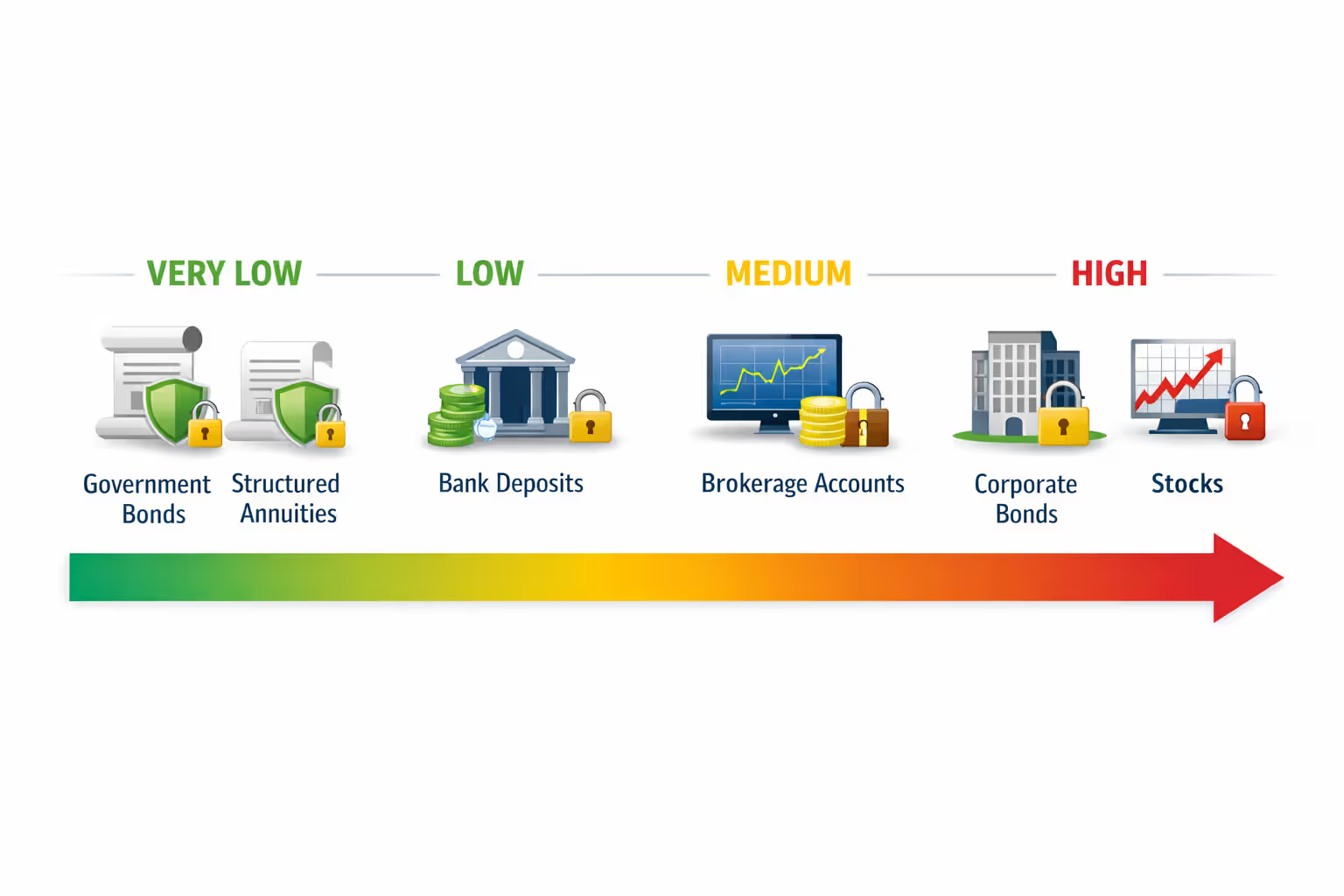
Comparing Protection Levels: Structured Settlements vs. Other Financial Instruments
Understanding how structured settlement financial security measures stack up against alternatives provides context for evaluating your options.
| Financial Instrument | Protection Type | Coverage Limit | Backing Entity | Risk Level | Liquidity |
| Structured Settlement Annuity | State Guaranty Association | $250K-$1M (varies by state) | State-mandated insurance fund | Very Low | None (fixed schedule) |
| FDIC-Insured Savings Account | Federal Deposit Insurance | $250,000 per depositor | Full faith and credit of US government | Very Low | Immediate |
| SIPC-Protected Brokerage Account | Securities Investor Protection | $500,000 ($250K cash) | SIPC fund (not government-backed) | Medium (covers fraud/failure, not losses) | Varies by investment |
| US Treasury Bonds | Federal Government Guarantee | Unlimited | Full faith and credit of US government | Lowest | Secondary market available |
| Corporate Bonds | None (issuer creditworthiness only) | None | Issuing corporation | Medium to High | Secondary market available |
| Stock Market Investments | None | None | None | High | Immediate (market dependent) |
This comparison reveals trade-offs. Treasury bonds offer unmatched security but provide lower returns and require active management at maturity. FDIC insurance protects bank deposits completely up to limits, but coverage caps leave large settlements partially exposed. Brokerage accounts provide flexibility but expose principal to market volatility.
Structured settlements occupy a unique position: they provide payment guarantees backed by multiple protective layers while eliminating market risk entirely. You sacrifice liquidity and growth potential, but you gain absolute certainty about future income. This certainty proves valuable for people who need reliable income to cover medical expenses, living costs, or care needs that will persist for decades.
The risk-return profile differs fundamentally from investing a lump sum. A diversified investment portfolio might generate higher total returns over 30 years, but it exposes you to sequence-of-returns risk—the danger that market downturns early in retirement could deplete principal before recovery occurs. Structured settlements eliminate this risk by contractually obligating payments regardless of market conditions.
Author: Danielle Morgan;
Source: avayabcm.com
5 Critical Questions to Ask About Your Settlement's Financial Guarantees
Before finalizing a structured settlement, verify these specific details to ensure you understand the protections backing your payments.
1. What is the annuity issuer's current rating from AM Best, S&P, and Moody's?
Don't accept vague assurances about "highly rated" carriers. Request specific ratings and the date of the most recent rating action. Verify these ratings independently through the rating agencies' websites. If the carrier holds ratings below A from any major agency, ask why this carrier was selected and what alternatives exist.
2. What is the present value of my annuity, and how does it compare to my state's guaranty association limits?
Your attorney should calculate the present value using appropriate discount rates. If this value exceeds your state's coverage limit by a significant margin, discuss splitting the settlement across multiple carriers. Some states allow this approach; others have restrictions. Understanding your exposure above guaranty limits helps you assess whether additional protections make sense.
3. Does the settlement include inflation protection or payment increases?
Ask specifically about cost-of-living adjustments, fixed percentage increases, or step-up provisions that boost payments at designated intervals. Understand the trade-off: initial payments will be lower if you include escalation features. Calculate whether the long-term inflation protection justifies accepting less money in early years when you might face immediate expenses.
4. What happens to remaining payments if I die before the settlement period ends?
Review the guaranteed period and beneficiary provisions carefully. Confirm that your designated beneficiaries will receive remaining payments and understand whether they'll receive periodic payments or a lump sum. Some settlements include commutation clauses allowing beneficiaries to receive present value; others require continued periodic payments. Estate planning implications vary significantly between these structures.
5. What documentation will I receive, and how do I verify the annuity was actually purchased?
You should receive a qualified assignment agreement showing the annuity issuer's obligation to make payments and documentation confirming the annuity purchase. Request a copy of the annuity contract or a certificate of coverage. Verify that the payment schedule in these documents matches what you agreed to in settlement negotiations. Discrepancies at this stage are easier to correct than after the settlement finalizes.
Frequently Asked Questions About Structured Settlement Safety
Structured settlement financial security stems from multiple protective layers working together: insurance company financial strength, state guaranty associations, and regulatory oversight. These mechanisms have proven effective through economic crises, with structured settlement recipients continuing to receive payments even when stock markets crashed and banks failed.
The protection level exceeds what most people can achieve managing lump sums independently, particularly for those who lack investment expertise or face cognitive challenges that make financial management difficult. However, these protections come with trade-offs—reduced flexibility, limited liquidity, and inflation risk unless you structure payments with cost-of-living adjustments.
Your decision should reflect your specific circumstances: the severity and permanence of your injuries, your ability to manage money effectively, your support network, and your future care needs. For people who require reliable income to cover ongoing medical expenses or living costs, the certainty structured settlements provide often outweighs the potential for higher returns from invested lump sums.
Verify carrier ratings, understand your state's guaranty association limits, and ask detailed questions about inflation protection and beneficiary provisions before finalizing your settlement. These protections work best when you structure payments thoughtfully during initial negotiations rather than discovering limitations later when modification options are limited or expensive.